This content is sponsored by Kaiser Permanente.
In the post-COVID workplace, Meghan Davies spends a lot of time walking.
Walking the hallways. Walking to meetings. Walking to and from the office.
As chief operating officer at Whitman-Walker Health, she finds value in talking with her team, knowing everyone’s names and making eye contact with patients.
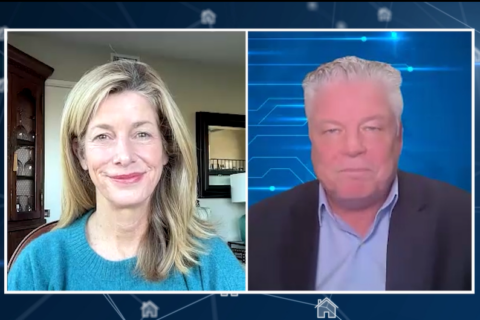
“Our tagline is, we see you,” she recently said while sitting for the Leadership In Action interview. “That’s our North Star.”
“You really need to balance to have a successful workplace heart, but also a culture of accountability,” she said. “I think health care is, you know, it’s money. You have to make sure that you have patient encounters and you’re bringing on insurance. But health care is nothing if it’s not heart.”
Davies, an 18-year veteran of Whitman-Walker Health, prides herself on knowing everyone’s names. And her team knows the names of her kids. She walks in the annual Pride Parade – there she is walking again – and she spends time circulating in the hallways.
She said the pandemic really tested the now half-century year old non-profit organization. She and her team had to work fast to provide telehealth services for patients and telework access for employees. So they headed to Costco and bought laptops for everyone on a Friday and then re-opened that following Monday, ready to go with telehealth.
“COVID was scary for everybody, but in health care, it was unique,” she said. “It wasn’t like we could just close the doors, right? We couldn’t say we’ll see you in a couple of years. We’re going to figure this out. We had to be part of the solution.”
In this post-COVID workplace, finding and retaining staffers, who often make less than other workers elsewhere in the health care space, can prove challenging. So what does Davies look for most when hiring?
“I think flexibility,” she said. “And when I say that what I mean is like every day is a roller coaster.”
And that is especially true these days, when government funding is no longer assured.
“We will get a grant cut, then we will find that we got a grant win, right? We will have a patient who dies. Then we will have a patient who is undetectable, with HIV. You have to be able to have these emotions, and if it’s either the heart or if it’s the mind, you have to move and pivot all day long. It can be exhausting, but you can’t show that to the patients.”
As chief operating officer, Davies has yet to embrace that title or the executive stereotype.
“In my mind, a chief operating officer is someone who is polished and they’re walking around with their binder, and they’re measured right, and they’re distant, and they know all the measures and the and the metrics,” she said. “That is not my form of leadership. I don’t believe that that would work at Whitman-Walker as an executive.”
“If you’re fake,” she said, “everybody knows it, right? Authenticity is what rules.”