This content is sponsored by The Lab School of Washington.
Not all kids learn the same way, and one local school has long made it its mission to make sure those children can thrive.
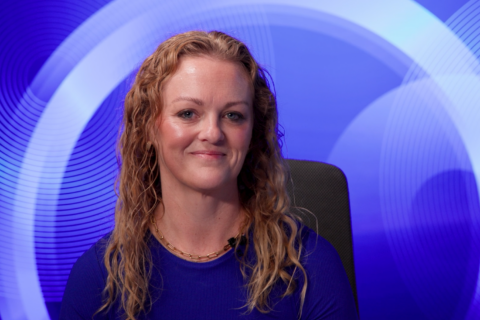
The Lab School of Washington was founded in 1967, “and we’ve had the same mission since day one, which is to serve students with language-based learning differences and ADHD,” said Kim Wargo, the head of the school.
The Lab School was founded by the mother of a dyslexic child who was struggling in class. “And she believed then, and we believe now, that every child has the capacity to learn, as long as they’re in an environment that understands who they are as a learner,” Wargo said.
How does that work for children with learning differences?
“The most important thing is that we believe that every child has unique strengths, and we start from those strengths to help kids work on the things that are hard for them,” she said.
Every Lab School student has a learning difference, “and that means that there are things that are harder for them than a neurotypical learner,” Wargo said.
As an example, she says students with dyslexia can really struggle to read. “But what we also know about learning differences like dyslexia is that they come with unique strengths: an ability to be creative, an ability to think about problems in a different way,” she said.
She said educators there also work to “demystify the idea that a learning difference is something to be ashamed of.”
Wargo said that “trying, sometimes failing, learning from your mistakes (and) figuring out what to do next” are skills that build resilience. “And if we think about the skill set that is necessary to be successful in life as an adult, resilience is probably at the top of the list.”
Wargo works with students with the help of numerous specialists, including occupational therapists, speech and language pathologists and mental health clinicians.
That team, of about 30 professionals, has the opportunity to work one-on-one with students in sessions “that are designed just for their needs,” she said.
Also, specialists can “give professional ideas to teachers who may be struggling with how to get a kid to get over a hump in their learning,” Wargo added. “It really enhances the experience for every student at our school.”
Wargo and members of the school community are especially proud of their robotics team, which, in its first year of entering competitive robotics at the middle school level, was ranked in the top 15% of teams nationwide and number one in D.C.
“Our kids excelled at this program – and this is not a competition for kids with learning differences,” Wargo said. “Our kids knocked it out of the park.”
So what’s the trajectory for someone with a learning difference? Whatever they want it to be, Wargo says.
Of students who stayed at the school through 12th grade and graduated, “100% of them last year were admitted to colleges and universities,” Wargo said.
The schools “range the gamut from the most highly selective types of schools in the country to schools that have very specific programs and services for students with learning differences,” Wargo said.
“And then once our kids go on to college and university, they are able to put into practice the self-advocacy skills that they learned at Lab,” she added.
“They go on to do every kind of job and profession you can possibly imagine.”