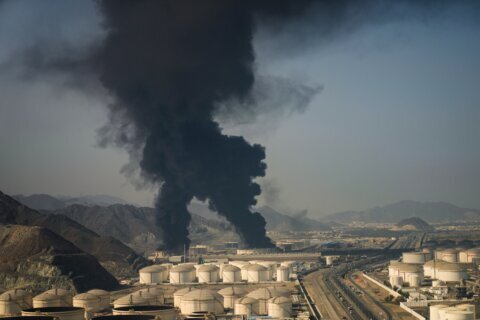
The Strait of Hormuz is a narrow channel between Iran and Oman that connects the Persian Gulf to the open ocean. It’s a small body of water with an outsized effect on the global energy market.
Amid U.S. and Israeli attacks that began Feb. 28, Iran said it would target ships passing through the chokepoint, which handles about a fifth of the world’s oil shipments. The international benchmark for crude oil recently traded above $82 per barrel, about 12% higher than just prior to the conflict.
As of early March 4, Brent crude hovered around $81, and West Texas Intermediate crude remained around $74 per barrel.
[Sign up for stock news with our Invested newsletter.]
How the U.S.-Iran Conflict May Impact Investors
Commodity investors have a lot riding on how the events at the Strait of Hormuz play out, not to mention the global economy. As the conflict in the Middle East deepens, here’s what investors need to know about potential impacts on the price of oil, natural gas and other commodities caught in the crossfire:
— How a shutdown at the Strait of Hormuz affects oil prices.
— Other commodities impacted by the U.S.-Iran war.
— Why crude oil prices haven’t exploded yet.
— U.S.-Iran conflict’s impact on oil stocks.
How a Shutdown at the Strait of Hormuz Affects Oil Prices
“Shutting down flows from the Strait of Hormuz is a major issue,” says Darrell Fletcher, managing director of commodities at Bannockburn Capital Markets. “Tankers can’t get insurance now and are stuck upstream.”
Tankers have also been hit by Iranian drones, and fighting has damaged oil infrastructure in Saudi Arabia and a liquefied natural gas facility in Qatar. As of early March 4, a U.S. submarine strike on an Iranian warship off Sri Lanka had intensified the clash at the Strait of Hormuz and hardened Iran’s resolve to shut it down. It’s the fifth day oil tankers have been stuck at the strait.
Iran produces around 3.5 million barrels of oil per day. Most of Iran’s oil goes to China, but rising oil prices because of the global disruption could raise gas prices for Americans by 25 cents for each $10 increase in the price of crude oil, says Usha Haley, an international business expert at Wichita State University.
That’s just one example of how the conflict is raising worries about inflation, as oil is essentially the lifeblood of the global economy, despite increasing use of renewable energy.
“If free passage through Hormuz is impeded for a longer period of time, say, a month or more, the U.S. may also probably see higher diesel and jet-fuel costs, leading to higher shipping and airfare costs, which again will trickle through the entire economy,” Haley says.
Other Commodities Impacted by the U.S.-Iran War
It’s not just oil that’s affected by the Iran conflict. Other commodities are on the move as well:
Liquefied Natural Gas
In addition to handling about 20% of global oil supply, the Strait of Hormuz also accounts for roughly 20% of the world’s liquefied natural gas trade. This commodity has transformed the natural gas trade from a largely regional affair limited by pipelines into a global trade supplied by ships carrying natural gas that has been chilled into liquid form. Qatar, which is a key LNG producer and exporter, has halted production after Iranian drone strikes.
Fertilizer, Grains and Soybeans
Natural gas is also a key input in making nitrogen fertilizer, and a significant portion of plant food is transported through the Strait of Hormuz. Rising fertilizer prices would increase the cost of growing grains and soybeans, and could result in higher food prices, further fueling the inflation scenario if the conflict in Iran is sustained.
“Continued conflict in the Middle East could have a significant knock-on effect, with consumers potentially paying the price as lower nitrogen application generally translates into lower crop yields and ultimately higher food prices,” according to Morningstar.
Aluminum
The Middle East is also an aluminum producer, and the Strait of Hormuz is key to the region’s supply chain. Aluminum futures traded in New York have risen about 9% since the conflict began.
Gold
Gold prices have also increased as market participants buy the metal as a safe haven and inflation hedge, but gains have been muted, perhaps because the precious metal has already had a historic run-up.
Why Crude Oil Prices Haven’t Exploded Yet
As for crude oil, there are a couple of reasons why oil prices haven’t shot even higher. First, the oil market is oversupplied. Second, and more profoundly, shale oil producers have expanded U.S. clout in the global oil market, limiting some of the economic fallout from the conflict.
“The spike in oil and gasoline prices during a major geopolitical event like this is significantly less because the U.S. has become the largest crude oil producer in the world,” says Rob Thummel, senior portfolio manager at Tortoise Capital.
Jeff Krimmel, founder of the energy market intelligence firm Krimmel Strategy Group, expects oil’s response to be less dramatic than some foresee because of a global surplus.
The International Energy Agency estimates a global surplus around 3.7 million barrels per day this year. The extra oil is coming as OPEC and its allies unwind voluntary production cuts; non-OPEC producers Brazil, Canada and the U.S. boost production; and a property-market downturn and weaker consumer demand in China decrease the Asian nation’s immediate need for oil.
Politics will also likely play a role in keeping oil price gains in check, Krimmel says.
“The Trump administration has been laser-focused on suppressing oil prices since taking office over a year ago,” he says. “With midterm elections approaching, the president knows his agenda is levered against election outcomes, and the U.S. will likely manage this conflict to avoid dramatic spikes in oil prices.”
In the short term, Trump has offered U.S. help with political risk insurance for tankers and military escorts through the Strait of Hormuz. Over the longer term, Krimmel expects political reform in Iran may allow more oil production and cause oil prices to drift lower and remain below where they would be under the pre-conflict status quo.
“If hostilities in the Middle East decrease over the long term as a result of change in the Iranian central government, oil prices will lose some measure of geopolitical risk premium,” Krimmel says.
Such a shift would take years and significant investment from large U.S. oil producers like Exxon Mobil Corp. (ticker: XOM) and Chevron Corp. (CVX), Thummel says. In that way, it’s similar to the situation in Venezuela, another major oil producer that the U.S. recently attacked.
“If the U.S. actions result in a change in regime, then it is possible that Iran could add to the future global oil supply,” Thummel says. “Like Venezuela, the major oil producers will need political clarity and political stability before making any significant capital investment.”
U.S.-Iran Conflict’s Impact on Oil Stocks
For now, higher oil prices have been lifting the stocks of producers slightly, with the State Street Energy Select Sector SPDR ETF (XLE) up about 1% since before the conflict.
“In the short term, the stocks of oil producers largely follow movements in oil price,” Krimmel says. “As oil price moves up, investors expect oil producers to capture more profits than previously expected, which encourages some share purchases on the margin.”
More from U.S. News
7 Best Oil and Gas Stocks to Buy in 2026
7 Best Natural Gas Stocks and Funds to Buy
5 Best Gold ETFs to Buy for 2026
Strait of Hormuz Gridlock: How the U.S.-Iran Conflict Impacts Oil Prices and More originally appeared on usnews.com