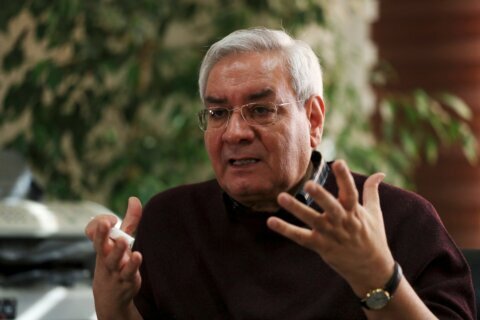
TRIPOLI, Lebanon — Ghassan Baytieh has staked out his turf in the city of Tripoli. One of about 10 large-scale private generator operators in the northern Lebanese city who can help provide electricity to homes and businesses when the government electricity is cut, Baytieh truly symbolizes power.
His business has come with some problems. Six years ago, Baytieh says, a local gang tried to extort money. The ensuing confrontation escalated into a gun battle that killed one man and injured two others — all of them from the other side, not his, he adds.
Such scenes aren’t unusual. In the city of Saida, south of Beirut, a dispute between competing electrical generator operators last October escalated into a gun battle that left two people dead.
Before civil war broke out in 1975, Lebanon had 24-hour electricity. But the 15-year conflict destroyed much of the country’s power infrastructure. Decades later, the sector has not been fully rebuilt and has not kept pace with the population’s growing demand for power. That means scheduled power cuts of three hours a day in Beirut and sometimes 12 hours or more outside the capital.
Financial problems at the state-owned power company and political dysfunction, among other issues, have prevented the national government from fixing the grid.
The private generator industry arose as a makeshift solution but has grown into a deeply ingrained industry. In wealthier areas, each building may have its own generator. In poorer communities, people buy power from neighborhood generator operators.
Baytieh says his entry into the private generator market 20 years ago was accidental. At the time, he had bought a small generator for his own business, a shop where people could make international phone calls.
“The neighbors started coming and asking to use my electricity, and the idea grew from there,” he says. Now , he employs 50 people and owns about 15 generators, each supplying as many as 60 houses during the hours when government electricity is cut.
Baytieh insists that the generator operators are doing a public service. Before the rise of the generator subscription industry, people bought small generators for their own apartments. The cost for fuel per month was higher than a subscription to a neighborhood generator, he says, and the generators were noisy, smoky and dangerous.
He doesn’t believe the country will solve its electricity crisis. “It won’t work, a solution — never,” he says. “This is Lebanon.”
Baytieh blames government corruption for the lack of progress. Others blame the generator owners.
Nabih Saadsebai, a Tripoli resident who owns a small DVD store, says he pays $100 per month for 10 amperes of generator electricity for the shop, on top of around $67 for government electricity. For his house, he generates his own backup electricity with a battery system that costs $800 and will last for about two years.
Saadsebai says some political leaders have tried to solve the electricity crisis. “But the generator owners wouldn’t allow it,” he says. “All of them in Lebanon don’t want a solution.”
[SEE: These Are the Most Corrupt Countries, Ranked By Perception]
Adding to the power woes are the financial problems besetting the state-owned power company, Électricité du Liban. EDL sells its electricity below cost, and in swathes of the country — including in some areas controlled by Hezbollah and other powerful political groups — people do not pay at all. In a 2010 report, Gebran Bassil, then Lebanon’s minister of energy and water, said EDL had $1.3 billion in uncollected bills and was running an annual deficit of $1.5 billion.
The report accompanied an ambitious — and largely unimplemented — plan to reform the electricity system and build new generation capacity. Plans to privatize EDL and set up an independent regulator also have never been implemented.
Meanwhile, the government has resorted to stopgap solutions, including the installation of a pair of floating power plants on barges stationed off the coast of Lebanon, rented from a Turkish company.
One local community managed to solve its own electricity crisis, at least temporarily. In the town of Zahle, in the Beqaa Valley east of Beirut, private power company Electricité de Zahle rehabilitated an old power plant, over the protests of generator owners. Its customers have been receiving 24-hour electricity since 2015.
But the company’s concession to distribute power expires this year, and Energy and Water Minister Cesar Abi Khalil has said it will not be renewed, meaning power distribution will revert back to the state power company. The owner of Electricite de Zahle declined interview requests; the energy ministry did not respond to requests for comment.
Walid Deghaili, an energy consultant and former EDL director of generation, blames the lack of progress on political corruption and uncollected bills.
“It is not interesting to increase generation if you are giving electricity free of charge to people,” he says. “When you have private production for the village or the street, you don’t give electricity free of charge.”
Indeed, Baytieh says he has never had issues collecting his bills: “Electricity is more important than food.”
Generator bills are another issue. Although the private generator market is technically illegal, the Lebanese government in 2011 set limits on the rates that generator owners may charge — currently, about 23 cents per hour for 5 amperes or 45 cents for 10 amperes. But the rules are spottily enforced, and residents say many operators still charge higher rates.
Apart from the expense and occasional violence stemming from turf wars, the generators present another, more insidious threat to the public. A 2012 study by researchers from the American University of Beirut found that in Beirut’s dense Hamra neighborhood, levels of airborne carcinogens were 60 percent higher during the hours when the government power was off and private generators were operating. Those private generators accounted for 38 percent of the daily carcinogen exposure in the area, the report found.
Alan Shihadeh, dean of the university’s engineering and architecture program, says the study’s findings should add urgency to the push for a solution to the electricity crisis.
And from a technical perspective, he says, the solution should not be difficult: Lebanon’s climate is ideal for solar power generation, and the country could solve the remaining generation shortage by building one or more “modern, high-efficiency” fossil fuel power plants in areas where the prevailing winds would carry pollution away from population centers.
“We have the people and the knowledge in the country to build the best power system in the region,” Shihadeh says. “We just have a rotten political system.”
[READ: Denmark Embraces Green Energy — and Braces for a Warmer Future]
In early February, the government announced that it signed the first public-private partnership with the energy sector, agreeing to work with three companies to create wind farms in the Akkar region north of Tripoli.
In recent months, some politicians have renewed calls for a push to 24-hour electricity. Timing may be crucial: The influx of more than 1 million refugees from neighboring Syria has brought new international attention and funding to Lebanon. But when the war ends, that attention — and money — will shift to rebuilding Syria.
Georges Sassine, a Lebanese energy policy expert, suggests that in the short term, private generators could be incorporated into the public system. Rather than selling their power to consumers on a black market, generator owners would sell the power to the government. Customers then would pay a single electricity bill rather than two, and prices would be regulated. As the country builds new power capacity, the generators would be gradually phased out.
“We have all these generators in the country,” Sassine says. “They pollute, they’re not cost-effective, but they’re there. The money has been spent. Let’s include them to be part of the solution.”
More from U.S. News
Microgrids and Energy Storage Create Sustainable Electricity Options in Face of Disaster
In Costa Rica, a Growing Movement to Ban Fossil Fuels
These Are the Most Corrupt Countries, Ranked By Perception
Lebanon Struggles to Rebuild Its Power Infrastructure originally appeared on usnews.com