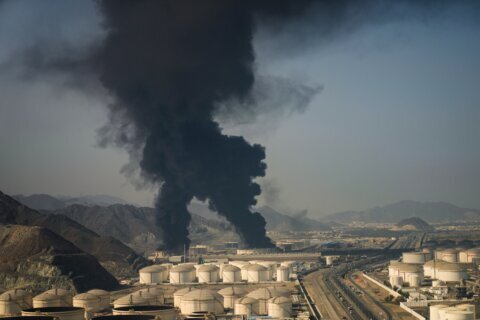
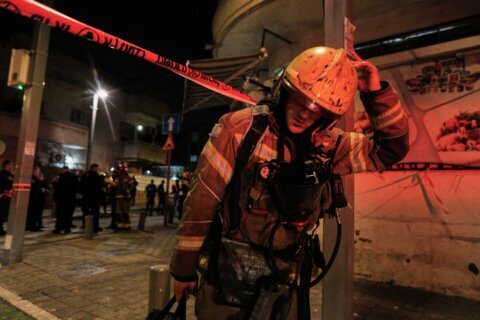
The Islamic State terrorist group and climate change are viewed as the two greatest global threats in 2017, according to a survey from Pew Research published Tuesday.
Furthermore, more countries view the U.S. as a threat than when Pew last asked the question in 2013. Global perception of the U.S. and the American president has plummeted since President Donald Trump took office in January.
Respondents from all but one of the countries — Turkey — say either climate change or ISIS are one of the two biggest threats facing their nations today, according to the survey of 38 countries and nearly 42,000 respondents conducted between February and May 2017.
Global fears are largely concentrated by region and political ideology, though: Europeans and conservatives are more likely to name ISIS or refugees as the biggest threats to their countries, while Latin Americans, Africans and liberals are more concerned about climate change.
In the United States, for example, 60 percent of conservatives say refugees are a major threat, compared with 14 percent of liberals. And 86 percent of liberals and 31 percent of conservatives are very concerned about climate change.
“Each individual country has its own politics, its own history, so we do see a lot of variation in many different countries on many of these threats, but overall across the globe, ISIS and climate change are definitely the two that rise to the top,” says Jacob Poushter, one of the study’s authors and a senior researcher at Pew.
An overwhelming majority of countries in the Middle East and North Africa say ISIS is the top threat to their countries — 97 percent in Lebanon, a country that has been plagued by attacks from the militant group.
Six of the seven South American countries surveyed say climate change is the biggest threat. Venezuelans say the condition of the global economy is a bigger threat than climate change, but only by a small margin.
The share of a country’s citizens who are concerned about the global economy depends on the standing of their nation’s economy, Poushter says. Venezuela and Greece, each embroiled in years-long economic crises, are the two countries most concerned about the global economy.
“The more people who say their own national economies are bad, the more likely they are to say the global economy is a major threat,” Poushter says, adding that the worldwide economy is viewed as the second-greatest national threat in 11 of the 38 surveyed countries surveyed, about half in South America.
In the Netherlands, conversely, just 12 percent of respondents say their own economy is bad and 21 percent say the global economy is a major concern. And while the Dutch are very concerned about ISIS, they are less worried about refugees.
The number of refugees from countries such as Iraq and Syria is considered the top threat in just one European country: Hungary, a country facing legal consequences from the European Union over its refusal to participate in a 2015 plan to relocate the large number of migrants arriving in Italy and Greece.
Only about 36 percent of Americans say refugees are a major threat — the U.S.’s top concern is ISIS, followed by cyberattacks from other countries. Japan is the only country more concerned about cyberattacks, while only about one-third of Russians are worried about hackers.
While allegations of Russian hacking have haunted the 2016 presidential election and the first months of Trump’s administration, the share of Americans who think cyberattacks are a major threat to the U.S. is comparable to before the election, Poushter says.
While 47 percent of Americans believe Russia’s power is a serious threat to the U.S., there is a sharp partisan divide: 61 percent of Democrats, compared with 36 percent of Republicans, perceive Russia as a major threat.
Concerns about Russia’s power are most prevalent in nearby Poland, where 65 percent of survey respondents say the Kremlin’s influence is a threat to the small Baltic nation.
An average of 50 percent of Middle Eastern and North African respondents say they are concerned about American power, compared with 35 percent who say the same of Russia and 20 percent who fear China’s influence. Sub-Saharan African countries, conversely, expressed little concern about the power of the U.S., China or Russia.
In Turkey, nearly three-fourths of respondents say American power and influence is a top concern to their country, just one year after a failed coup attempt partially blamed on the U.S. — a significant jump from the 44 percent who said the same in 2013.
The survey’s findings about the U.S. as a potential threat add to growing data showing the world’s view of the country under the Trump administration has dipped significantly. In addition to the June Pew results, a series of polls at the beginning of the year showed the new U.S. president being highly unpopular in Germany.
“The image of the United States and confidence in the U.S. president has dropped pretty dramatically in the past year since the end of the Obama presidency and the start of the Trump presidency,” Poushter says. “There’s definitely a growing anti-Americanism around the world, so we would expect the number of people seeing the U.S. as a potential threat, because of that, to change.”
More from U.S. News
Survey Shows Global Disapproval of U.S. President Donald Trump
Russian Authorities Increase Crackdown on Cultural Dissent
The U.S. Is Losing the Battle for Influence in Africa
Pew Survey Shows ISIS, Climate Change Viewed as Leading Security Threats originally appeared on usnews.com