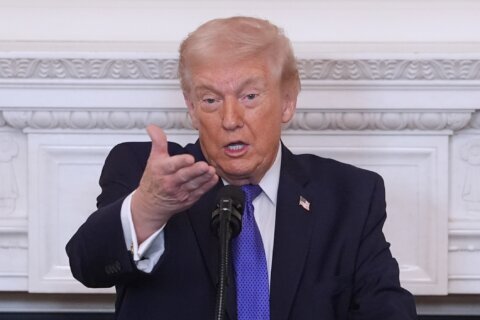
Defense stocks like Boeing Co (ticker: BA) and Lockheed Martin Corp. ( LMT) have come under fire in recent weeks after provocative tweets from President-elect Donald Trump vowing to slash costs on their respective programs.
From a man who has talked tough on national defense — he famously said he would go after terrorists and their families — these recent tweets cast doubt on just how much the military industrial complex will benefit from a Trump presidency.
When 140 characters erases billions. On Dec. 6, less than an hour before the opening bell on Wall Street, President-elect Trump took aim at Boeing, America’s single largest manufacturing exporter.
[See: 7 of the Best Stocks to Buy for 2017.]
“Boeing is building a brand new 747 Air Force One for future presidents, but costs are out of control, more than $4 billion. Cancel order!” tweeted Trump, whose Twitter handle is @realdonaldtrump.
Markets immediately responded, and BA stock fell 1.6 percent in pre-market trading. The market value of the loss was about $1.5 billion.
Thankfully for shareholders, the slump was brief. Shares recovered throughout the day after Boeing responded with a fact-checking statement of its own, clarifying that it was only under a $170 million contract to “determine the capabilities” of the next Air Force One.
But Trump’s unpredictable and notoriously itchy Twitter fingers weren’t done altering the outlook of major defense stocks, and a Dec. 12 tweet targeting a Lockheed Martin contract showed yet again his newfound power to move markets, swiftly and meaningfully.
“The F-35 program and cost is out of control. Billions of dollars can and will be saved on military (and other) purchases after Jan. 20th,” Trump tweeted.
LMT stock plunged after the Tweet, briefly shedding more than 5 percent, or the equivalent of $4.1 billion in market value.
The F-35 is a fighter jet made by Lockheed Martin, and it’s also a veritable money machine. It’s Lockheed’s single largest program, accounting for 20 percent of its overall revenue.
It’s certainly true that the F-35 program could use some cost control: The 15-year development of the jet set the U.S. government back about $400 billion, more than double its original budget. It’s already the most expensive weapons system in history, and maintenance and operation of the planes is expected to top $1.1 trillion over the course of the fleet’s projected lifetime.
LMT stock wasn’t the only “loser” from the Dec. 12 tweet. Northrop Grumman Corp. ( NOC), which manufactures the F-35’s center fuselages, saw shares drop as much as 7 percent in the hours after Trump’s tweet. From peak to trough, the loss knocked $3.1 billion off the company’s valuation.
Trump’s tweets have become such financial events that “there are some traders who have supposedly even made algorithms to trade based on his tweets,” says Carol Roth, author of the New York Times bestselling book, “The Entrepreneur Equation.”
Trump, trading and uncertainty. Roth sums up the trouble with these Trump tweets: “If he follows through on these thoughts, that of course would have an impact on those industries and their corresponding valuations — and potentially stock prices as a result.”
“If he doesn’t, it will more likely be short-term trader action that doesn’t impact long-term investors,” Roth says.
Most people don’t have the time, resources, inclination or expertise to go plugging Trump‘s Twitter feed into a trading algorithm, so the question becomes: will he or won’t he follow through?
That’s the exact sort of uncertainty that the market notoriously loathes. But it’s worth looking at both potential outcomes.
[See: 20 Awesome Dividend Stocks for Guaranteed Income.]
On one hand, Trump tends to speak in hyperbole and could just be sweet-talking the American taxpayer. This is a man who has promised to “knock the hell out of ISIS” and advocated killing terrorists’ families. That sounds militaristic and expensive.
“Trump has taken a much more hawkish stance toward world events” than Hillary Clinton, says Robert Johnson, president and CEO of The American College of Financial Services. “I believe that we will see rising military budgets despite the recent tweets.”
On the other hand, a far more notable part of Trump’s selling point as a candidate was his status as a successful businessman. Promising to negotiate better deals for America? That means cost-cutting.
Between Trump’s tweets affecting BA and LMT, more evidence Trump might be prioritizing cutting defense costs popped up on Twitter. The president-elect retweeted a story from The Washington Post entitled: “Pentagon buries evidence of $125 billion in bureaucratic waste.”
“A very interesting read. Unfortunately, so much is true,” Trump rather ominously commented.
Trump’s increasingly combative rhetoric towards defense contractors has escalated to the point that a Reuters headline proclaimed: “Trump attack on Lockheed Martin foreshadows war on defense industry.”
Back to reality. The president-elect has publicly stated that “you want to be unpredictable” in regards to the use of nuclear weapons, and that appears to be his stance toward defense spending and policy more broadly as well.
Still, in the case of many government defense or military deals, the U.S. is already several years into a long-term contract, or there is almost no legitimate alternative supplier. Is Trump going to cancel the next generation Air Force One, call the $170 million a sunk cost, and put it out to bid? Probably not. But going forward, defense contractors should brace for a new world: a world with lower margins.
That means investors should brace themselves, too.
Dave Louton, a finance professor at Bryant University, believes that the defense industry will still make a pretty penny under President Trump — you don’t need to worry about an absolute portfolio meltdown. With that said, market assumptions that caused defense stocks to rally after Trump’s election aren’t looking quite as rock-solid anymore.
[Read: 5 Reasons Donald Trump’s Presidency Will Include a Recession.]
“Given the run-up that we have seen in their stock prices since the election it may be time for a reset,” Louton says.
More from U.S. News
10 Ways to Invest in Pharmaceuticals With ETFs
8 Stocks to Buy For a Starter Portfolio
8 of the Most Incredible Investments of the 21st Century
Defense Stocks: Not So Safe After All Under Donald Trump? (BA, LMT) originally appeared on usnews.com