MCKEES ROCKS, Pa. — Before his time in the Ohio state Senate, the U.S. House of Representatives and the Ohio governor’s mansion — and long before he emerged as a long-shot candidate for the White House — John Kasich was just a kid from McKees Rocks.
Kasich, the third-place candidate in the race for the Republican presidential nomination, grew up in the McKees Rocks/Stowe Township area, only about a five-minute drive from downtown Pittsburgh and just up the hill from the manufacturing facilities that once brought thousands of jobs to the region.
“McKees Rocks was the place where all the boys went to the top of the hill and played from sunup to sundown,” says Kasich’s sister, Donna. Her brother “was very competitive, very energetic and active and involved with everything. He was active in the church, and I’m sure you must of heard we called him ‘Pope’ when he was younger.
“He was such an overachiever.”
Kasich worshiped at the Mother of Sorrows Church — a building now featuring aged and broken signage that would make it difficult to identify if it wasn’t so large. The cramped houses surrounding the church also have seen better days, with chipped and collapsing porches and rusty metal fences dividing property lines. The church’s neighbor on a narrow, uneven road is a brick shed with a collapsing roof, most of its glass windows broken in.
Kasich was a student at Sto-Rox High School before moving on to Ohio State University. The governor has reflected on his time at Sto-Rox out on the campaign trail, recalling the tight, salt-of-the-earth community from whence he came.
“In McKees Rocks, you come in our town, you beat us in football, we’ll break every freakin’ window on your bus. You don’t want to mess with us,” he said earlier this year in an interview with The Washington Post. “People who think, ‘I get screwed, I get nothing’ — that’s where I grew up.”
The name of Kasich’s high school alma mater is an amalgamation of Stowe and McKees Rocks, two separate but closely knit communities where access to Pittsburgh’s river system, proximity to major railroad tracks and overall industrial output combined to form one of the more prosperous areas in western Pennsylvania until the 1950s and 1960s.
“This community has always been an important place in western Pennsylvania. And when you think about its location, we are on the Ohio River, just a few miles from downtown Pittsburgh,” says Taris Vrcek, executive director of the McKees Rocks Community Development Corp. and a third-generation resident of the region. “In the late 1800s, Pittsburgh and Lake Erie Railroad opened up their maintenance facility here. This was where locomotive engines were repaired. And this went from being farmland to being a community almost overnight.”
But eventually, urban dwellers began migrating farther out to the suburbs, and some of the area’s factories began to shut down. By the early 1980s, Vrcek says the area was “pretty much eviscerated.” And although he is helping to plan a series of revitalization projects and public-private partnerships to bring more investment into the area, he says poverty now plagues McKees Rocks.
“You had this huge decline happen and this exodus. This was always kind of a blue-collar, working-class community, but what replaced the workers who worked at the mill and so many of them who walked to work when there were thousands and thousands of jobs here … was people coming here for cheap housing,” he says. “You have a high concentration of poverty that is generational, in many cases, that has its origins in these public housing facilities.”
The Census Bureau shows McKees Rocks held a population of a little more than 6,000 in 2014, and the bureau recently estimated about 28 percent of people there live in poverty. Median household income in the region also stood at a little more than $26,000, and only 12.6 percent of the population held a bachelor’s degree or higher. Both metrics were less than half the state average.
The median value of owner-occupied housing in McKees Rocks was only $48,000 — less than a third of Pennsylvania’s state average.
“It was still a good place to grow up,” Vrcek says. “The town really looked out for each other. That was really a mainstay of the town. My dad would say this all the time — and I think Gov. Kasich has used this, too — but the thing that makes McKees Rocks great is that we look out for each other.”
And now that one of their own is running for president, Vrcek says there’s “great pride” among locals that “transcends politics.”
“Out of all those people, if I was to vote for a Republican, it would be Kasich. He’s the only one who speaks like he’s got a little bit of sense,” says Herbert Thomas, a Korean War veteran and registered Democrat who was born and raised in McKees Rocks.
“I like some of the stuff that he did [in Ohio],” says Ric Johnston, a Republican and maintenance worker from just outside McKees Rocks. “This week, as a matter of fact, I’ve started to see more Kasich signs up.”
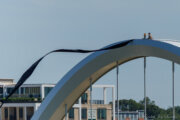
Indeed, after crossing into town over the iconic, powder-blue McKees Rocks Bridge — which stands in contrast to many of the other black, gold and silver bridgeways that have given Pittsburgh its City of Bridges nickname — visitors are greeted by a handful of Kasich signs. But on that same plot of land, there are also a handful of Bernie Sanders and Donald Trump advertisements, as well as a few signs supporting state and local candidates.
And therein lies the problem for Kasich in Pennsylvania — he’s being drowned out by the cacophony of what’s been a crowded and contentious primary season, even in his hometown.
“Kasich hasn’t been able to use [his connection] effectively,” says G. Terry Madonna, a public affairs professor and director of the College Poll at Franklin & Marshall College in Lancaster, Pennsylvania.
That poll’s most recent findings, released Thursday, showed GOP front-runner Trump holding a substantial lead over Kasich and Texas Sen. Ted Cruz. About 40 percent of likely Republican voters are expected to back Trump in Tuesday’s primary, according to the poll. Only 26 percent are expected to support Cruz, with Kasich bringing up the rear at 24 percent.
Other polling from Monmouth University and CBS News/YouGov also put Kasich third in terms of support, and show Trump poised to run away with the state.
Madonna says Kasich falls short in part because much of McKees Rocks and surrounding Allegheny County has historically leaned left, with Vrcek describing the region as being “fiercely Democratic.”
“I think a large portion of McKees Rocks is probably Democrats,” says Donna Kasich, who spent part of Saturday going door to door in nearby Bethel Park, Pennsylvania, on behalf of her brother. “We did meet some Democrats who said they wished they could have voted for John.”
The governor’s sister says she saw a “very positive reaction” as she traveled around Pittsburgh from both Republicans and Democrats. But supportive Democrats can’t help Kasich on Tuesday, and there’s no guarantee they’d be helpful in November should he somehow become the GOP nominee.
“It’s pretty Democratic around here,” says Diane, a McKees Rocks local, while pushing one of her children in a stroller and attempting to keep pace with another running down the street. She declined to give her last name. “I haven’t decided yet. I’m going to vote next week. I’m a Democrat. But I haven’t decided yet.”
And despite his kind words for Kasich, Thomas — whose car sports a Hillary Clinton bumper sticker — says he’ll be supporting the Democratic front-runner.
“Here’s a lady that’s been the wife of a president for eight years, she’s been a senator out of New York. She’s been a secretary of state. None of these other people have those credentials,” he says.
Even in just the Republican race, the high level of poverty in McKees Rocks doesn’t bode well for Kasich’s chances of winning his home county.
Madonna says many lower-income voters may shy away from a more establishment candidate in favor of someone more radical who is promising more immediate change — i.e., Trump.
“I’m actually surprised out of the people I talk to. There’s a lot of interest in Trump because of what he’s doing to the process,” Johnston says. “I’m going to vote for Trump. I like Cruz a lot. But the ticket I picked when this all first started was Trump and Cruz — a businessman and a constitutionalist.”
Johnston says “business is suffering terribly” in the region and that Trump is the most likely candidate to turn things around. He says he supported GOP candidate Mitt Romney in the 2012 election in large part because of his business experience.
“I don’t know if Trump can do it, but I just like that he’s stirring the pot,” he says. “Being the big question mark that he is, I see him as a one-term president.”
Asked whether he thought Kasich would make a strong showing in the area, Johnston says he thinks the candidate could claim “maybe McKees Rocks, but that’s about it.”
The governor’s sister, though, says she’s used to seeing her brother “succeed in seemingly impossible situations.”
And she says she has no reason to think this election is any different.
“A lot of people [I’ve talked to] said he was the only serious candidate. ‘Reasonable,’ ‘presidential,’ ‘qualified.’ Those were the trends I heard,” she says. “He has these fundamental beliefs and philosophies from my parents. He has a tireless work ethic. And everything he says is real, so you take it for what it is.”
More from U.S. News
Maine’s LePage Says Heroin Overdose Medicine ‘Doesn’t Truly Save Lives’
Clinton Commands Home-Field Advantage in Tuesday’s Pennsylvania Primary
Trump Denies He Is Changing His Tune
John Kasich’s Hometown Support in Pennsylvania May Not Equal Votes originally appeared on usnews.com