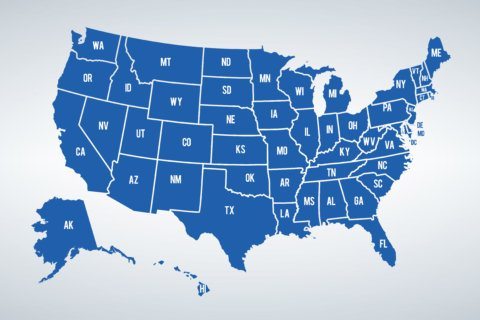
NEW YORK (AP) — The aspirations cut a wide swath through American history since 1776, from the country’s name — the UNITED States of America — to the sentiment of the motto written in Latin on its coins and one-dollar bills: E Pluribus Unum, or “out of many, one.”
The desire for unity has been optimistic and unrealistic, successful and a failure, enduring as an American ideal during moments when citizens struggled — and struggle today — to practice it.
How has the notion of unity in American society evolved, what does it mean — and what doesn’t it mean, particularly in fraught and troubled moments?
Aspirations vs. reality
The founders emphasized unity would be a vital component for the new country. But defining it was far from settled.
“It is of infinite moment that you should properly estimate the immense value of your national union to your collective and individual happiness; that you should cherish a cordial, habitual, and immovable attachment to it,” George Washington said as he stepped down from two terms as the first American president.
Even as the founders spoke of high-minded ideals, they put limits on who they allowed to take part. All these years later, determining unity’s meaning can still be a challenge. Is it a blending of different perspectives to create a country that is greater than the sum of its parts, or does unity requires sameness?
There’s never been just ONE America, where everyone lived in the same way or had the same access to power and prosperity. It wasn’t there at the country’s inception. And in the moment the U.S. is living now, it certainly isn’t either.
“I think the United State has had a more volatile history in terms of how it deals with questions of inclusion and exclusion, how it draws the line and polices the line of who’s in and who’s out,” says Daniel Immerwahr, a professor of history at Northwestern University. “It’s a question that every society has to answer … who’s on the inside, who’s on the outside.”
Sometimes the differences have been straightforward — like geography (rural vs. urban, plains vs. mountains) and climate (heat vs. snow, wildfires vs. flooding). Sometimes they were, and remain, cultural — people from different countries of origin, newcomers vs. generations deep.
But sometimes, the differences have been travesties — like enslaved Africans and their American-born descendants, forced to live under the lash. Even after slavery was outlawed, they were subject to discrimination and worse under racism that was legalized in systemic ways into the 20th century and that echoes still.
The Indigenous tribes whose populations were decimated as newly arrived settlers hankered after their tribal lands, and whose cultures were stripped as the U.S. government tried to force “unity” through brutal efforts at assimilation.
Communities of people barred from possibility because of gender, sexual orientation or other characteristics.
There have also been efforts over the eras to create a country where the opportunities available only to some would be made available to all, through protest movements, legal action, and callbacks to those same American founding ideals and aspirations of unity and equality.
“It provided a language for the groups that were challenging these exclusions to draw on … invoking the ideals of the Revolution and the Declaration and saying, ‘Look, this is what the nation is supposed to be about,’” says Eileen Cheng, a professor of history at Sarah Lawrence College.
What could ‘unity’ even look like?
What does “unity” even mean? Is unity overall even a good thing in the context of a raucous democracy? A look around the globe and through the history books shows there’s no single answer.
“There are always tensions between the unity and the separateness,” said Paul Wachtel, a psychology professor at the City College of New York. “There’s no society that is just one or just the other … what’s really most essential is that we learn how to negotiate those tensions.”
The United States experienced that firsthand in its infancy. The Constitution we live under is the second attempt at a framework for government. The first, the Articles of Confederation, kept the federal government in a weaker position and individual states stronger. It quickly became clear that having that weak a central government — i.e., less unity — wasn’t effective for the new country, leading to the Constitution.
The United States has a decidedly mixed history when it comes to dealing with those tensions.
Take migration, for example. There have been eras when the influx of people coming to these shores was seemingly a never-ending stream, but also times when much of the world was barred. In politics, the idea that there would be different factions represented by different parties was loathed by some, even as it became embedded in the political culture.
“What have we learned over the last 250 years is that things change,” says Cindy Kam, professor of political science at Vanderbilt University. “We are inclined to be social animals, but what those groups are is culturally constructed.”
And the demographic, technological, economic and other changes of the last several decades are making discussions about unity more relevant than ever. In recent years, Americans have lived in a country where polarization is rampant, and serious — sometimes dire — questions abound over what the future holds. That’s probably more in line with the country’s beginnings than people realize.
“This polarization, people talk about it like it’s a new thing. But I think it’s really a return back to the way that we were at the beginning of the country,” Cheng says. “It’s not like this kind of linear development where we’re growing more and more accepting of difference. I think it’s up and down.”
___
This story is part of an Associated Press package looking at the United States at age 250. For more stories, click here.
Copyright © 2026 The Associated Press. All rights reserved. This material may not be published, broadcast, written or redistributed.