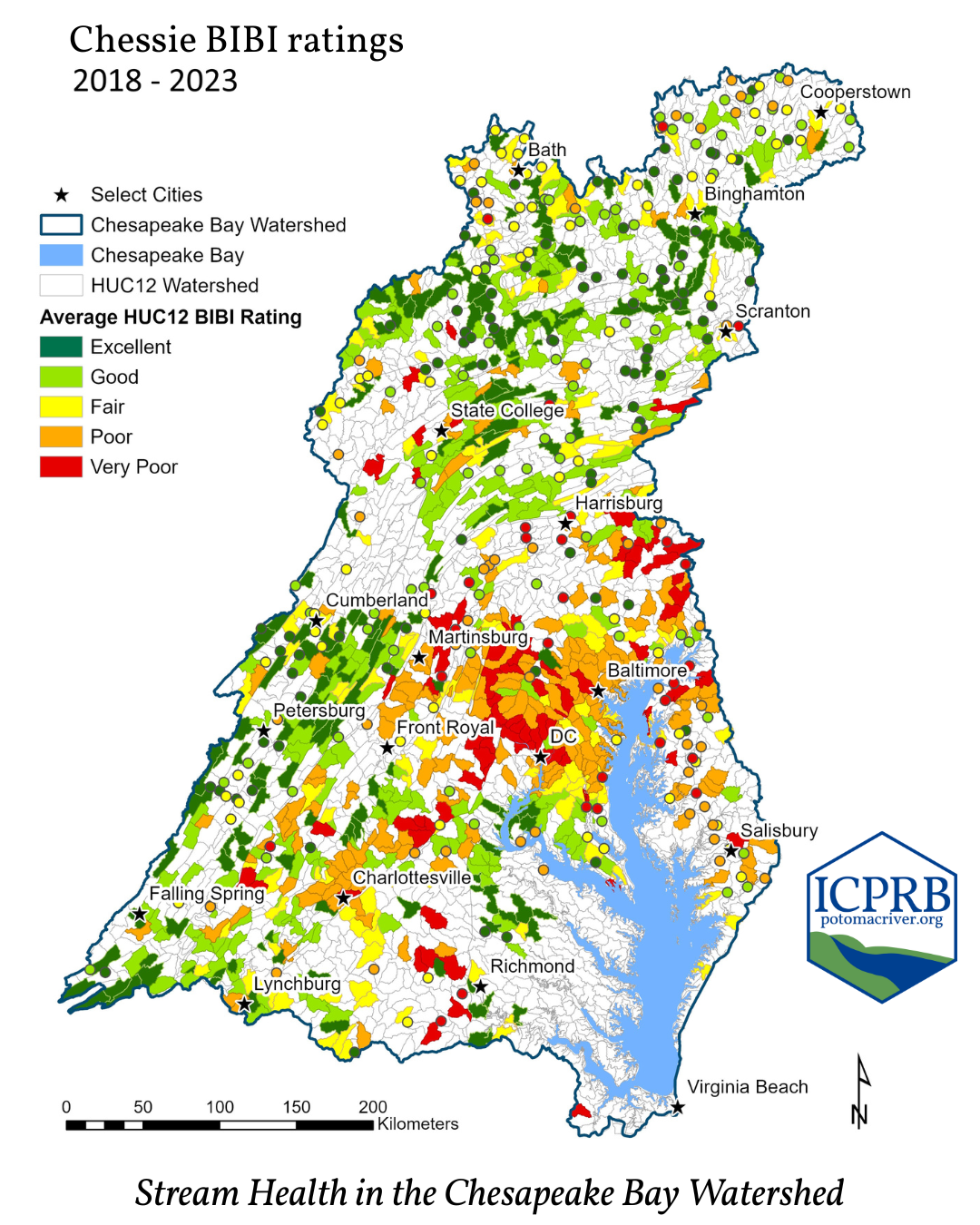
Over the past six years, the streams in the Chesapeake Bay watershed — which covers 64,000 square miles — has become cleaner.
According to the latest data from the Interstate Commission on the Potomac River Basin, there’s been a 1.4% improvement in overall stream health throughout the watershed.
If you’re wondering why that matters, Renee Bourassa, the director of communications and education with ICPRB, poses this question: “Do you drink water? Everybody drinks water!”
Area streams feed into rivers, and the Potomac River, for example, is the water source for millions of residents in the D.C, area, from the District of Columbia to Arlington, Fairfax and Loudon counties in Virginia.
Bourassa explained that the Chesapeake basin-wide index of biotic integrity, or “Chessie BIBI,” is the yardstick used to measure the water quality.
“It’s a really long way of saying what species (of invertebrate) and how many of them” can be found in the watershed’s streams, she said.
Because invertebrates are sensitive to changes in water quality, Bourassa said, “If we’re finding them in a stream, that’s a good sign it’s a healthy stream.”
The organisms that help tell the story of just how healthy streams are include “creek critters” that spend most of their life in the water before they become “the bugs that we know and love, like dragonflies,” Bourassa said.
“That means the water coming out of your tap might also be a little bit cleaner,” she said.
According to the report, the latest data shows that an estimated two thirds of the 145,000 stream miles of the Chesapeake Bay watershed can be rated as either fair, good or excellent.
The next Chessie BIBI report will cover the years from 2024-29.
Get breaking news and daily headlines delivered to your email inbox by signing up here.
© 2025 WTOP. All Rights Reserved. This website is not intended for users located within the European Economic Area.