D.C. region leaders said the cost of repairing the massive Potomac Interceptor pipeline break continues to rise, and new testing could soon reveal the full impact of the January spill.
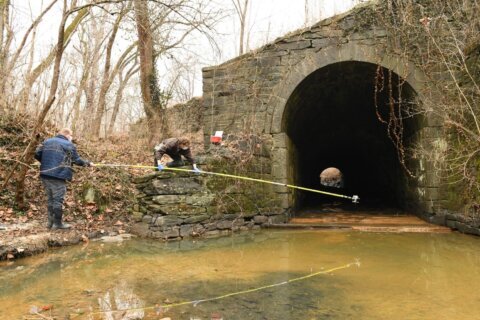
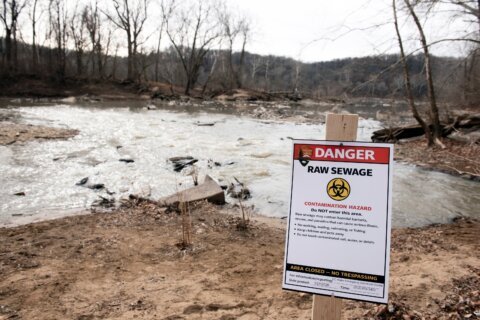
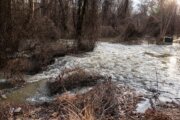
The rupture happened along the Clara Barton Parkway near the Capital Beltway. Since January, the collapse has dumped 240-340 million gallons of sewage into the C&O Canal and the Potomac River.
Metropolitan Washington Council of Governments officials said Wednesday that the estimated cost for emergency repair work has now climbed to about $30 million. That number covers the immediate response and rehabilitation efforts, but it is believed that cost could still rise.
Longer-term improvement and modernization estimates for the decades-old sewer line over the next five years are at roughly $390 million, with another $600 million expected over the next decade as the full pipeline is rehabilitated.
COG leaders stressed that the collapse will not be resolved with just an emergency repair but a major infrastructure investment that will stretch well into the future.
“On cost, the near-term emergency work is important, but the long-term challenge is really going to be the rehabilitation program for the Potomac Interceptor,” Steve Bieber, COG’s water resources program director, said.
Because the Interceptor is a federally authorized interstate sewer line serving D.C., Maryland and Virginia, COG and regional partners are already seeking help from the federal government for the costs associated with updating the pipes. That includes a $395 million request through the Water Resources Development Act to pay for the five‑year rehabilitation and modernization plan for the line.
Bieber said the region’s congressional delegation has been “very receptive” and is exploring other possible avenues, including supplemental appropriations, to help cover the hefty bill.
Is it safe to kayak or row in the river?
COG is also launching new testing to understand how the spill affected the river. One test is a microbial analysis with Arizona State University, which looks for germs in the water and measures possible risks to people who use the Potomac River recreationally and help answer some of the questions many people have.
“Is it safe to kayak? Is it safe to row?” Bieber said, adding that the results should be available within a month.
Another test, done in coordination with researchers at the University of Maryland, focuses on nutrients and sediment that settled into the riverbed after the spill. That analysis of the mud and soil compares new samples with the results of samples tested three years ago, which Bieber said gives scientists a good baseline.
“All of that data will be collected and used to help support near-term public health and water quality decision making as the pipe gets fixed,” Bieber said.
As regional coordinator, COG has brought together the response from D.C. Maryland, Virginia, as well as federal agencies
Some leaders urged D.C. Water and others involved in the cleanup to be more transparent about what comes next.
D.C. Council member Charles Allen, who sits on the COG board, warned that contamination remains a concern and that the cleanup will be slow.
“They’ve not put out a full environmental remediation plan so that people can have comments and feedback on that,” Allen said.
Allen also raised concerns about recent report from the Potomac Riverkeeper that cited high E. coli levels downstream of the bypass system and warned the full cleanup will take “months and months and months” to complete.
Emergency work continues at the spill site, and the damaged sewer line may be able to carry flow again as early as next week.
Get breaking news and daily headlines delivered to your email inbox by signing up here.
© 2026 WTOP. All Rights Reserved. This website is not intended for users located within the European Economic Area.