By any historical measure, the words mattered as much as the action.
In the wake of the U.S. operation that seized Venezuelan President Nicolás Maduro, White House Deputy Chief of Staff Stephen Miller did something no senior White House official had done so bluntly in decades: he articulated a doctrine. Not a talking point. Not a trial balloon. A worldview.
“We live in a world, in the real world, that is governed by strength, that is governed by force, that is governed by power,” Miller said on CNN Monday night. “These are the iron laws of the world that have existed since the beginning of time.”
That statement, delivered without apology or hedging, amounts to a declaration that the United States is abandoning the post-World War II framework that has guided American power for 80 years. In its place is something older, harder and far less restrained: a return to raw great-power logic, where sovereignty is conditional, law is optional and legitimacy flows from dominance.
This was not rhetorical excess. It was strategic disclosure.
For decades, U.S. presidents of both parties wrapped the use of force in layers of justification: alliances, international law, congressional authorization, humanitarian necessity. Even when those constraints were bent or broken, they were at least acknowledged.
Miller’s formulation rejects the premise outright.
Under this emerging doctrine, the United States does not lead because it is bound by rules. It leads because it is strong. Smaller states do not possess inviolable sovereignty; they possess relevance only insofar as they align with U.S. interests. Multilateral institutions are not guardrails. They are inconveniences.
That logic now appears operational.
The Venezuela raid was not framed as war, even as it involved hundreds of U.S. personnel, air and sea power, and a direct breach of another nation’s sovereignty. Congressional authorization was dismissed as unnecessary. Oversight was treated as a liability. The distinction between law enforcement and warfare was blurred to the point of irrelevance.
What mattered was the result and the message.
A hemisphere reclaimed
Miller’s comments did not stop with Venezuela. They were paired with warnings to Colombia, demands directed at Mexico, threats toward Iran and a striking assertion that Greenland “should be part of the United States” because of its strategic value and America’s superior power.
Taken together, these statements point to a revived sphere of influence strategy. The Western Hemisphere is framed as U.S.-controlled space. The Arctic is cast as a prize to be secured. Compliance is assumed; resistance is dismissed.
This is not alliance leadership. It is territorial logic.
The administration’s own messaging reinforces the shift. A State Department post declaring “This is Our Hemisphere” would once have been unthinkable in an era defined by collective defense and mutual sovereignty. Now it reads as a mission statement.
What is notably absent from this new posture is any clear sense of limits.
There is no articulated end state for Venezuela. No transition plan. No reconstruction framework. No explanation of how long U.S. pressure, presence or coercion is intended to last. The operation is described as “ongoing,” a word that signals permanence rather than resolution.
This is a strategy built on motion, not destination.
Historically, such approaches carry costs that compound quickly: military overstretch, economic retaliation, intelligence blowback and the normalization of escalation. Miller’s doctrine treats those risks as secondary. Power, in this view, justifies itself.
A break with the American century
Perhaps the most consequential aspect of Miller’s statement is what it rejects.
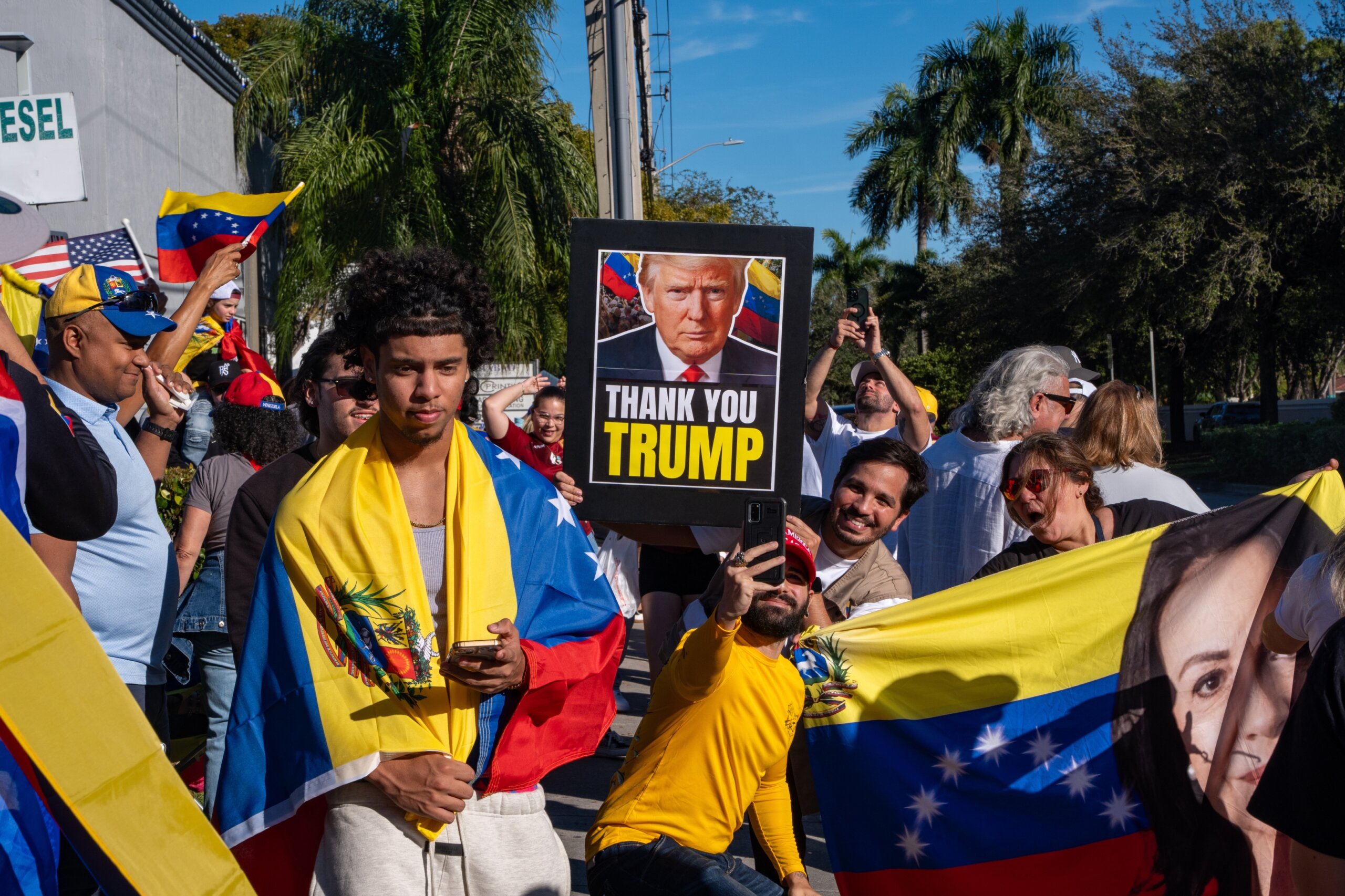
The Atlantic Charter, the United Nations, NATO and the postwar consensus all rested on a shared principle: that powerful nations should not impose their will on weaker ones simply because they can. That principle was never perfectly upheld, but it was foundational.
Miller’s formulation discards it entirely.
In its place is a vision of the United States not as a system-builder, but as an enforcer; not as a guarantor of order, but as its ultimate arbiter. It is a philosophy closer to the 19th century than the 20th, one that measures success in acquisitions, submission and fear rather than stability or consent.
The signal to the world
Allies are being told, implicitly, that protection is contingent. Adversaries are being told that restraint is gone. Congress is being told that its role is advisory at best. Voters are being told, perhaps without realizing it, that American power will be exercised more openly, more unilaterally and with fewer brakes.
Whether that is what the country intended is an open question.
What is no longer in doubt is this: Stephen Miller has named the doctrine. The administration is acting on it. And the world is being put on notice that the era of American power with permission may be over.
Get breaking news and daily headlines delivered to your email inbox by signing up here.
© 2026 WTOP. All Rights Reserved. This website is not intended for users located within the European Economic Area.