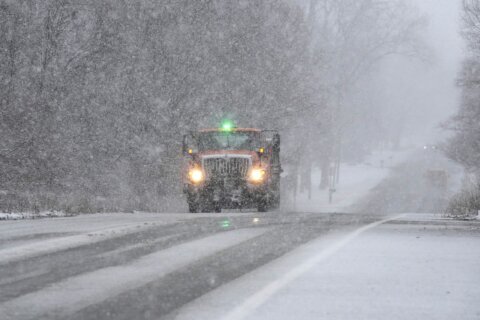
Last summer, the Department of Public Works and Environmental Services in Fairfax County, Virginia had three months worth of meetings on which areas and facilities to prioritize in the aftermath of a winter weather event.
The county manages over 10.8 million square feet of pavement across the Northern Virginia suburb, and has to ensure libraries, government centers, shelters and police and fire stations are treated and then cleared.
Virginia’s Department of Transportation, meanwhile, is responsible for clearing most roads.
As this weekend’s storm approaches, county officials have had as many as seven meetings each day, coordinating parking at various facilities and discussing ways to execute those plans they first considered months ago.
“This is the Super Bowl,” said Chase Suddith, an emergency management specialist for the Department of Public Works and Environmental Services’ stormwater management. “This is the most fun part of my job. It’s prepping for all of it, and then it’s executing.”
The county uses a tiered system to figure out which spaces it should prioritize. Police stations, fire stations, emergency services and the judicial complex are considered “Priority 1” locations. There will always be crews nearby, Suddith said, so they can respond to emergencies.
Health centers and similar facilities are second, and libraries, community recreation centers and police and fire training academies are third.
Crews use over 100 plows and work in 12-hour shifts, and chat notifications are nonstop. As Suddith monitors the storm from the Storm Command Center, crew members send images back in real time.
Orange markers are placed near curbs to ensure officials can determine where they’re located.
The groups brine the parking lots and sidewalks, and after an inch of snow has accumulated, the plowing begins. When it concludes, the curb to curb work begins.
After a 9-inch storm, for example, Suddith said the county would aim to have Priority 3 locations cleared from curb to curb about 72 hours after the snow stops.
Meanwhile, as the storm arrives, Suddith is expecting to get about six hours of sleep each night. And given the circumstances, he’s urging residents to be patient.
“It is going to be so cold afterward that it is going to be very challenging for us to get to what we normally expect,” Suddith said. “More salt is not better. The salt is not going to be as effective once temperatures get below 20 degrees.”
Get breaking news and daily headlines delivered to your email inbox by signing up here.
© 2026 WTOP. All Rights Reserved. This website is not intended for users located within the European Economic Area.