This article was republished with permission from WTOP’s news partner InsideNoVa.com. Sign up for InsideNoVa.com’s free email subscription today. Read the article on Inside Nova.
Prince William County Public Schools is implementing several changes to its grading, assessment and reporting practices beginning in the 2026-27 school year.
The updated practices are the result of a multi-year review and planned phase-in process that included research, comparison with neighboring school divisions, analysis of current grading practices and feedback from students, families, teachers, principals and central office staff.
The updates emphasize mastery of learning standards, meaningful feedback and academic growth while aligning the division’s grading practices with neighboring schools and many colleges and universities, according to school officials.
As the updates are introduced, students and families can expect the following changes, the school system said:
Updated grading scales for grades 6-12, including the introduction of “minus” letter grades.
Clearer expectations for assessments, with consistent weighting by school level, including: elementary school – 40% formative (practice and feedback) / 60% summative (demonstration of learning); middle and high school – 30% formative / 70% summative.
Clearer guidance for reassessment opportunities, homework practices, gradebook reporting and final grade calculations
Continued alignment with student supports and accommodations, including Individualized Education Program, 504 Plans and English learner services
Greater consistency in grading practices across schools
At both the middle and high school level, under these changes, the penalty for late work will not exceed a letter grade, however, late work will not be accepted after two weeks barring unique exceptions.
The scorecard is below.
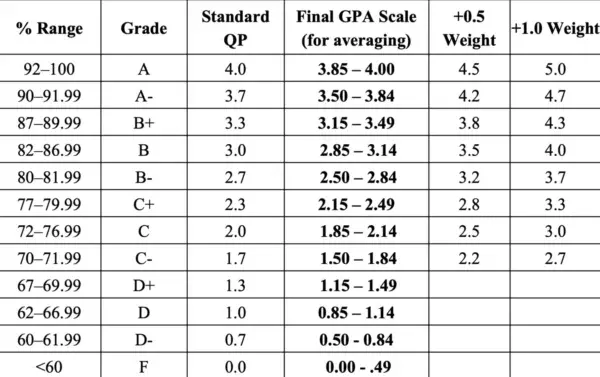
The introduction of “minus” letter grades for grades 6-12 is intended to create a third band of “distinction” for more accurate modeling and is also in alignment with most peer divisions and post-secondary institutions.
The school system aligned many of the grading practices for the middle and high school levels in an effort to help prepare students as they enter the high school years.
“Right now our students hit a cliff in ninth grade – much more rigorous standards, much more expectations, and we don’t want that to be the first time they experience it,” said Stephanie Soliven, the associate superintendent for teaching and learning.