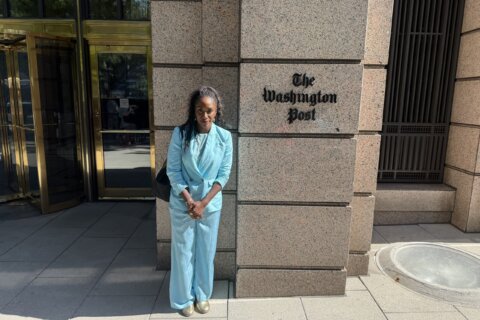
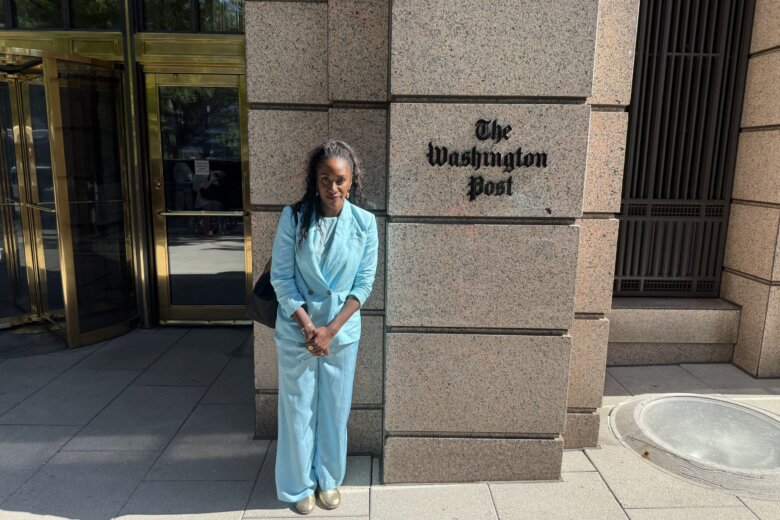
For over a decade at The Washington Post, Karen Attiah was writing opinion columns on race, culture, gender and human rights.
Then, in September 2025, after the death of conservative activist Charlie Kirk, she posted on social media about America’s double standards relating to political violence and said Kirk was “a white man that espoused violence.”
In her termination letter, her former employer said her social media post “violate(s) The Post’s social media policies, harm the integrity of our organization, and potentially endanger the physical safety of our staff.”
Attiah, the Washington Post Guild and the Washington-Baltimore News Guild filed a grievance against the news organization to challenge her firing, arguing that it went against press freedom.
“We’re just living in a climate right now where there are so many attacks on press freedom, attacks on our institution that I think for me personally it just felt right,” Attiah told WTOP before her arbitration hearing.
“I was just doing my job and to be punished for just doing my job. I had to fight back.”
Attiah said she sees her firing as part of the changing media landscape that includes mass layoffs, eliminations of news departments and attacks on the press, among others.
“It’s an extremely pressure-cooker time for journalism and journalists,” she said.
Attiah isn’t alone in the fight as she has a ton of supporters, including the Washington Association of Black Journalists (WABJ), the largest chapter of the National Association of Black Journalists.
“Karen Attiah’s firing was another example in the worrying pattern to stifle and silence Black voices,” Phil Lewis, president of the Washington Association of Black Journalists. “As an opinion columnist, Karen’s role is to help readers sit with uncomfortable truths. We need those voices now more than ever.”
Confidence about her case
The hearing on Thursday was long, as both The Washington Post and the Washington-Baltimore News Guild made their arguments. Attiah was called to testify about the Bluesky post after Charlie Kirk’s death that led to her firing.
Amos Laor, general counsel of the Washington-Baltimore News Guild said she explained she was “eventually fired for doing exactly what she was hired to do.”
“What she was trained to do, what she was evaluated in, what The Post evaluated for and The Post praised her for doing writing opinions, writing smart and sharp social media posts with commentary on the pressing issues of the time,” such as race and political violence.
Laor and Attiah are both confident that they made a compelling case and their chances of prevailing in this arbitration.
“I made a very strong, solid case that there was no cause for termination,” Attiah said.
Laor said the decision will be made by a neutral arbitrator within two to three months.
“It was an opportunity for Attiah to finally present her story because she was 11 years (as a) columnist of The Post,” Laor said.
“This was, I think, an important moment for Attiah to finally get the opportunity to present her side and to argue against her wrongful termination.”
Curiosity as a journalist
Although she hails from Texas, Attiah’s background has roots in West Africa. Her mother is Ghanaian-Nigerian and her father was Ghanaian. She said her heritage contributed to her curiosity of the world.
“I’m curious how other people live, other cultures live. So I brought that to my journalism. … To be able to bring voices from other backgrounds, other cultures, other countries,” Attiah said. “It’s foundational to me as a journalist.”
When she worked at The Washington Post from 2014 to 2025, she wrote on high-profile stories, including pieces about Jamal Khashoggi, the Saudi journalist whom she recruited to the Post in 2017 and who was killed in 2018 by the agents of the Saudi government.
Attiah edited his last article for the newspaper.
She also wrote about the Nigerian government bringing back girls who were kidnapped by Boko Haram.
“Generally, my interest and passion was to help people who were being oppressed and having their voices taken away, and using a platform at the post to be able to help people,” Attiah said.
In 2019, she and fellow columnist David Ignatius were awarded the George Polk Award for their commentary on Khashoggi’s killing.
Diversity in journalism
As the last full-time Black opinion columnist for the paper, she believes that diversity is important so that people know what’s going on in the diverse communities and how it shapes the news coverage.
“It just enriches the journalism, brings more readers, brings more money,” Attiah said. “This is a key part of why I wanted to enter journalism … to help empower other voices.”
She hopes that in her fight against her termination from The Washington Post and against the attacks on diversity and DEI, journalists are inspired to fight back.
“I think for me it’s to demonstrate not only fighting back individually, but the importance of organization, solidarity, collective action and just that our voices matter,” Attiah said. “They matter, they’re worth fighting for.”
WTOP reached out to The Washington Post for comment on Attiah’s firing and arbitration hearing.
Get breaking news and daily headlines delivered to your email inbox by signing up here.
© 2026 WTOP. All Rights Reserved. This website is not intended for users located within the European Economic Area.