D.C. traffic cameras issued hundreds of thousands of tickets last year, and city leaders say their presence alone has made streets and neighborhoods safer.
A large increase in traffic cameras last came in 2024, and now, there are 215 speed cameras, 55 red light cameras, 31 stop sign cameras, 10 oversized overweight truck cameras and 25 school bus stop arm cameras.
The city also has 210 cameras tied to WMATA buses. Those issue tickets to drivers parked in bus lanes.
For years, some drivers have been critical of the city’s traffic camera program, suspecting it’s an attempt to increase revenue for D.C.
Now, Pennsylvania Rep. Scott Perry is leading a measure in Congress to ban the city’s use of cameras.
But Sharon Kershbaum, director of D.C.’s Department of Transportation, said the program is having an impact on driver behavior.
“It’s a key tool in our tool kit, and we want to continue to use it,” Kershbaum told WTOP. “We would be handcuffed in terms of really trying to improve traffic safety if we didn’t have it available.”
In deciding where to put the cameras, Kershbaum said city leaders consider requests from the community indicating where there’s a need for traffic calming. Typically, concerns can be addressed by using an engineering solution. But when that approach doesn’t yield the desired result, a camera is considered.
Separately, the agency proactively installs cameras in crash-prone locations or other problematic streets and intersections.
“Nobody likes getting fines, but there is a huge demand here when people are just fed up,” Kershbaum said. “A lot of our stop sign cameras are in areas near schools, near parks, in areas where we have a lot of vulnerable road users and people are desperate, because when you’ve got a reckless driver, there is very little that an engineering solution can do.”
Once a camera is put in place, it’s likely to remain there for at least a year or 18 months, Kershbaum said. DDOT conducts before and after assessments, and evaluates whether drivers are following the speed limit and obeying red lights and stop signs.
The agency is refining the threshold used to determine whether to move a camera, Kershbaum said, and the goal is to be in a position to track driver behavior even after a camera moves locations.
The city, she said, has reported a 50% reduction in speeds that are up to 25 mph over the speed limit, and a 35% reduction in speeds more than 25 mph over the speed limit. Similar improvements have been documented in areas that have red light and stop sign cameras.
D.C. has a dashboard that shows the locations of different types of cameras throughout the city.
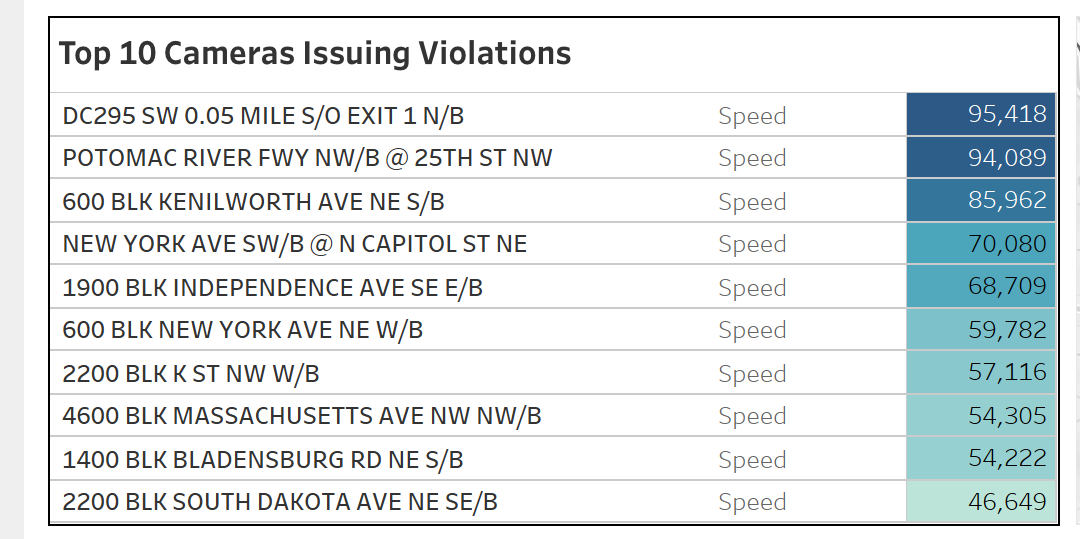
In fiscal year 2025, the top speed camera was along Route 295. It issued 95,418 tickets.
Others in the top 10, including one along the Potomac Freeway, regularly appear on lists of most violations.
Generally, Kershbaum said, about 70% of drivers who receive a speed camera ticket only get one. Fifty-eight percent of license plates only have one violation, according to city data.
“Cameras work for the majority of the people who want to be in compliance. They don’t want to have tickets rack up,” Kershbaum said. “There’s always going to be a subset of extremely reckless drivers. … Cameras are not going to fix it for everybody. It is one of many tools in our tool kit.”
Almost 60% of violations last year were issued for drivers going 11-15 mph over the speed limit, according to city data. The second-most amount of tickets were issued for passing a stop sign without fully stopping.
About 18% of tickets were given to cars with D.C. plates, compared to 27% from Virginia and 41% from Maryland.
In response to community members who suspect the cameras are an effort to boost revenue, Kershbaum said she’s “not even aware of how much money we collect. It is a nonfactor in our decisions about where to put cameras.”
In the first half 2025, the city collected over $110 million in fines from traffic cameras.
“I get demanded from our residents that we do things to make our roads safer, and this has been a critical tool in our tool kit,” Kershbaum said. “I don’t know how to state it more clearly. And if you don’t like getting tickets, don’t get one.”
Get breaking news and daily headlines delivered to your email inbox by signing up here.
© 2026 WTOP. All Rights Reserved. This website is not intended for users located within the European Economic Area.