D.C. Mayor Muriel Bowser indicated she’s working to not only mitigate the impact of a massive sewage spill in the Potomac River, but to protect District residents from footing the bill to repair D.C. Water’s wastewater pipeline.
A segment of D.C. Water’s Potomac Interceptor collapsed last month, leading to one of the worst sewage spills in the nation’s history.
During a news conference for the groundbreaking of a new recreation center in Southeast D.C. on Thursday, Bowser was asked about how the cost of making repairs to the Potomac Interceptor, a pipe that carries wastewater to the city, would be covered.
“This is a D.C. Water asset,” Bowser said initially. “D.C. Water is responsible for fixing its pipe.”
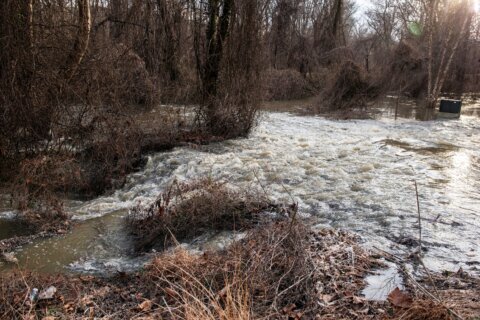
The spill was caused by break in a 72-inch-wide segment of the 60-year-old pipeline, shooting millions of gallons of sewage out of the ground and into the river.
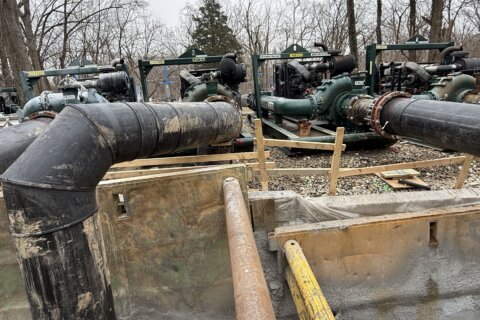
Thursday, D.C. Water crews were able to reach the collapsed pipe section, after bringing in high-capacity pumps to divert sewage from the Interceptor into an isolated stretch of the C&O Canal, around the collapse site, and back into the pipeline.
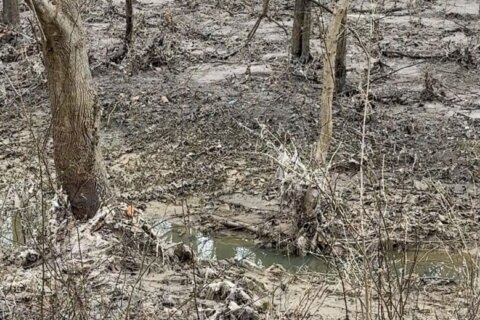
Using heavy machinery and digging by hand, crews are removing sludge and rocks up to the size of boulders, before being able to get into the pipe to assess the damage. D.C. Water estimates it will take 4-6 weeks to excavate the area, repair the pipe, and restore wastewater flow to the Interceptor.
Wednesday evening, Bowser had declared a local public emergency, and asked the federal government to assist in the cleanup and repairs — a move that came after President Donald Trump criticized regional officials for their response to the break, which happened in mid-January.
Bowser said D.C. Water has spent billions of dollars on its infrastructure, and along with distributing drinking water to District residents, provides wastewater services to parts of Maryland and Virginia.
“We’re different. We are the nation’s capital, and so we think that there is a role for the federal government in speeding up those investments” in the system’s infrastructure, Bowser said.
She bristled at one reporter’s question on whether the D.C. government took the sewage spill “seriously” in the days following the pipeline’s collapse last month.
“I have to correct you,” Bowser said. “We’ve always taken it seriously.”
The initial break sent millions of gallons of sewage flowing into the Potomac River until crews were able to come up with a system to funnel the leaking wastewater into the C&O Canal, allowing it to bypass the Potomac River and be channeled back into the Interceptor.
Bowser said D.C. has an emergency management response structure, including a number of offices and agencies in D.C. government.
“I’m at the top of that structure,” Bowser said.
She added that when it came to the District’s emergency declaration: “This one is a little bit different, because the lead responding agency is not a D.C. government agency, but a quasi-government agency.”
According to the D.C. Water website, the agency has been in contact with the U.S. Environmental Protection Agency, the Maryland Department of the Environment, the Federal Emergency Management Agency, the District Department of Energy and the Environment, the Maryland Governor’s Office and other regional officials as the repairs continue.
Get breaking news and daily headlines delivered to your email inbox by signing up here.
© 2026 WTOP. All Rights Reserved. This website is not intended for users located within the European Economic Area.