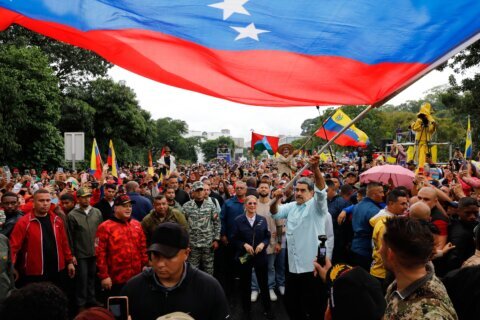
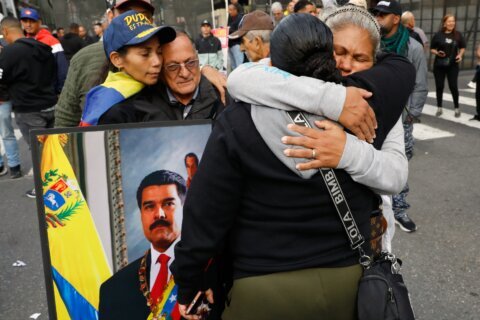
A small group of Venezuelans, their loved ones and advocates gathered Sunday at the General Simón Bolívar Memorial near the National Mall to celebrate the capture of President Nicolás Maduro and his wife, Cilia Flores.
President Donald Trump announced over the weekend that U.S. military forces captured Maduro and Flores in an overnight raid on their home. Both were brought to the U.S., where they face narco-terrorism charges.
The U.S.’ overnight military operation knocked out electricity in parts of Venezuela’s capital Caracas and included strikes on military installations. All of this was followed by Trump’s remarks that the U.S. would “run” Venezuela in the interim.
Many in the U.S., however, remain divided over Trump’s invasion and capture of another country’s leader, especially considering the lack of congressional approval to carry out the operation. Critics worry it will drag the U.S. into another costly war, saying the president is only doing this to gain access to Venezuelan oil.
But, Maduro’s capture is also being welcomed by many Venezuelans as he is widely seen by opponents — within his country and by foreign governments — as having illegitimately won Venezuela’s 2024 election.
The memorial statue where Sunday’s festivities took place honors Simón Bolívar, popularly known as “The Liberator” for his work securing the independence of multiple Latin American countries, including Venezuela, from Spanish rule in the 1800s.
‘The usurper president’
In attendance was Gabriela Montero, an award-winning Venezuelan pianist and human rights advocate who performed at the 2025 Nobel Peace Prize ceremony for Venezuelan opposition leader María Corina Machado.
“This is not a matter of the U.S. coming in and taking our riches and taking our resources. This is about removing from office a group, and in this case, right now, the usurper president, and allowing, in this next phase, a space for a transition which will finally lead the road to our freedom,” Montero said.
When asked if he had any reservations about U.S. military action in Venezuela, Montero’s husband Sam McElroy responded, “none, whatsoever.”
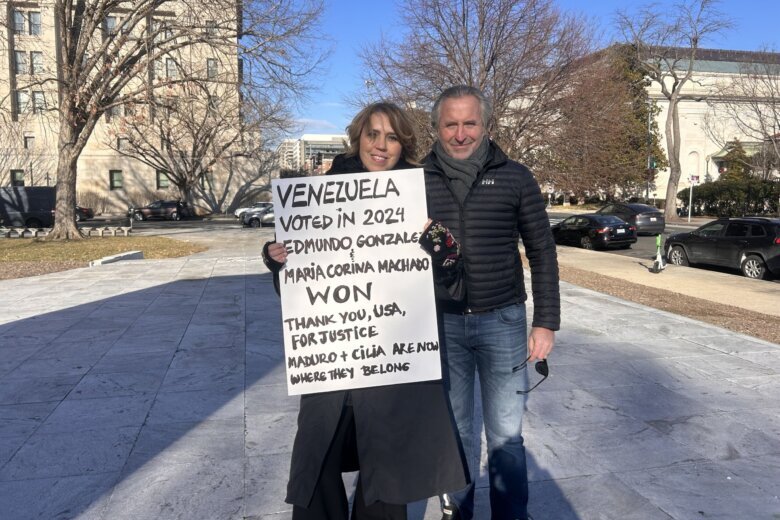
“I can fully understand why people, for example, are concerned about the extrajudicial nature of the bombing of the boats, and how this was done without an act of Congress, or without consulting Congress. But, you also have to deal with the problem as you see it and as you find it,” McElroy said.
“It was an extraction of two criminals, not an extraction of a president, because he’s not the president of Venezuela. He was the illegitimate usurper, a criminal who was extracted. So we must get that right.”
Both Montero and McElroy consider Edmundo González to be the legitimate winner of the 2024 presidential election.
“Venezuelans, we have, for the last 20-plus years, voted. We’ve marched. We’ve tried to find our way to democracy through democratic means,” Montero said.
“We’ve done everything that was required of us as a peaceful people without the arms that the military and the government, unfortunately, own, and we’ve done everything that we could to be able to free ourselves and to become a democratic state again, and it’s been impossible.”
Carlos Figueroa attended Sunday’s celebration with his family.
He expressed gratitude to the Trump administration, saying he never thought he’d see Maduro brought to justice for creating “unbearable conditions” in Venezuela. He said that after decades, many Venezuelans who initially fled the country will feel safe coming home.
“The rule of law is not yet restored in the country. When that happens, then, of course, millions of Venezuelans will return back. And, definitely, that’s my expectation too,” Figueroa said.
‘Hands off Venezuela’
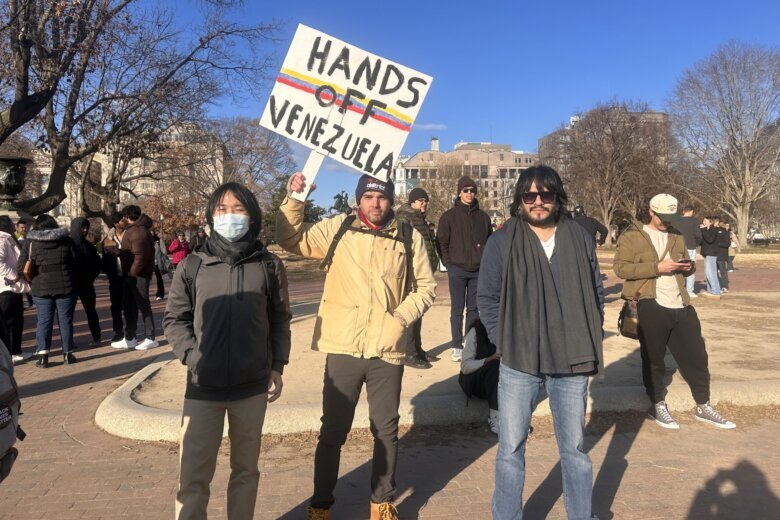
Just blocks away at the White House, another small group gathered, but with different intentions: to protest both U.S. military action in Venezuela and the capturing of Maduro and Flores.
Robbie McLuckie was part of that group. He held a sign reading, “Hands off Venezuela.”
“I’m just really concerned about the military action on Venezuela. I think it should have gone through Congress and the Trump administration took unilateral action and impacted the sovereign rights of another country,” McLuckie said.
“Obviously, Maduro is a complicated, bad guy. He wasn’t a good leader. He mistreated his people. But, that doesn’t mean we need to be invading other people’s countries without congressional approval, kidnapping their leader, and bringing them back. I think that’s really scary.”
Also part of that group was a demonstrator named Jose, who shared similar concerns.
“We know very well that, you know, the natural resources are one of the primary interests to do all these kinds of attacks,” Jose said.
“You know, I’m from Bolivia, and Bolivia, we have one of the biggest resources of lithium, and we know that this is going to happen to us. If that happened to Venezuela, we are next.”
But Venezuelans, like Montero and Figueroa, remain steadfast in their support for the Trump administration’s operation.
“A lot of people think they understand Venezuela. They’ve just arrived in the conversation. We’ve been in this fight for 27 years,” Montero said.
“Ask a Venezuelan, ask us what our story is, ask us how much we suffered and we’ve lost. Ask us, you know, to inform you, to educate you. Don’t presume to know, because this is a complex situation.”
Get breaking news and daily headlines delivered to your email inbox by signing up here.
© 2026 WTOP. All Rights Reserved. This website is not intended for users located within the European Economic Area.