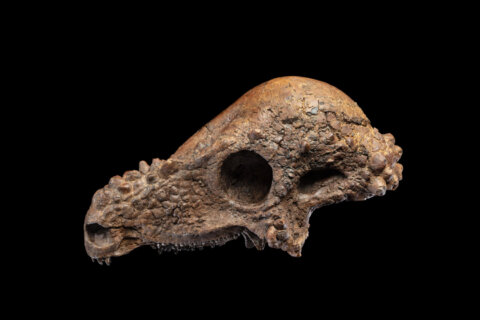
For the next week, dinosaur enthusiasts are getting a special treat at the Smithsonian National Museum of Natural History. A nearly complete skull of a thickheaded dinosaur seen in the “Jurassic Park” franchise is now on display.
The Pachycephalosaurus walked on North American land 67 million years ago, just a million years before the asteroid impact that wiped them out from the Earth.
The nearly complete fossil was discovered in 2024 in South Dakota. It was purchased and donated to the museum by Eric and Wendy Schmidt this year.
“These dinosaurs are somewhat familiar because of their very, very thick skulls. They almost look like a bowling ball on the top. They can be six to nine inches of solid bone on the top. And perhaps not surprisingly, that’s the part we usually find,” Matthew Carrano, the museum’s curator of Dinosauria, told WTOP.
He said that thick skull is usually the part that survives after decay and millions of years underground.
A popular theory as to why those skulls are so thick is because they were the “big horn rams” of the dinosaur era, constantly knocking heads for dominance.
“Another possibility is they’re just knocking each other around, maybe not head-to-head. But it could also be something to do with sort of display and signaling,” Carrano said. “A lot of animals will do very elaborate things with their heads as a way of showing off. Maybe there were bright colors on it. Maybe there were things in the skin that we don’t see now … so I think there’s a lot of avenues that we can still take to try to understand that.”
Finding a nearly complete skull with teeth and smaller bones that have been preserved inside the skull like the one on display here is very rare.
“I’ve been here more than 20 years, (this is) one of the most exciting additions to the dinosaur collection in all that time,” Carrano said.
It will be on display at the Fossilab until Dec. 28 and then it will undergo a year or two of intense research.
“Some (scientists) suggest that Pachycephalosaurus looked quite different when it was young, but other scientists think actually those are a completely different species. So by having this skull, which is very complete and not fully grown, I think we can maybe start to solve that riddle,” Carrano said.
It will eventually be on permanent display at the Fossil Hall.
Get breaking news and daily headlines delivered to your email inbox by signing up here.
© 2025 WTOP. All Rights Reserved. This website is not intended for users located within the European Economic Area.