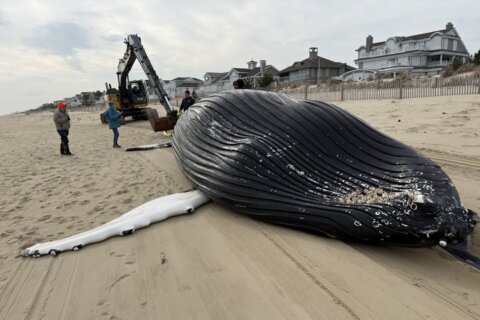
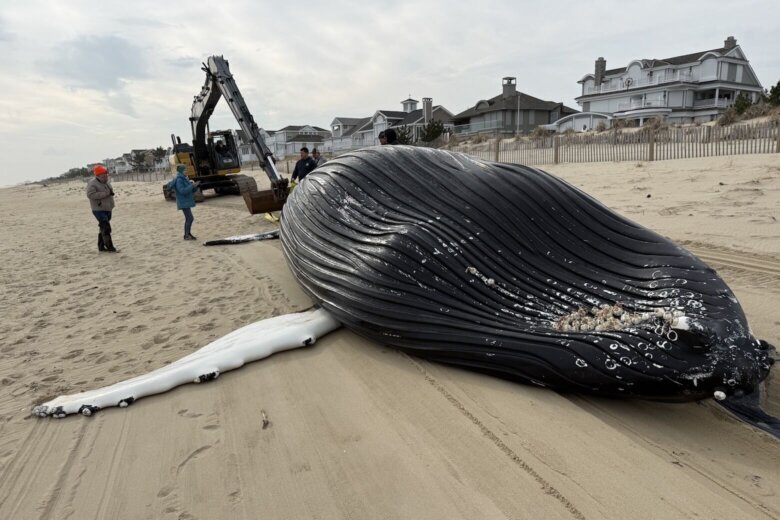
A dead 2-year-old humpback whale washed ashore in Bethany Beach, Delaware, on Thursday.
When it came ashore, Suzanne Thurman, with the Marine Education, Research and Rehabilitation Institute, a group that responds to marine life in need, went to the beach.
“The whale was actually on our radar because it had been sighted two days prior to coming in toward the beach,” Thurman said.
Thurman said while they did their best to observe the whale’s condition from land, it was dangerous to do an up-close examination.
“It’s being moved by the waves, and in the case of this animal, it was 32-plus feet, and so it weighed an estimated 20,000 pounds or more. So, if it were to roll on top of us, that would be the end of us,” Thurman said with a laugh.
Another risk of going around a whale in the water is that the animal is a major food source for sharks.
Once on land, Thurman performed a necropsy on the animal, which revealed the animal had possibly been struck by a ship.
With the ports of Wilmington and Philadelphia not far away, Thurman said instances of ships striking whales are not uncommon.
“It’s also a migratory pathway for large whales, and so the combination of the two makes for more collisions than we would like to see,” Thurman said.
Once questions about how it died were answered, the next question was: What do you do with the carcass of a 10-ton whale?
“It doesn’t get towed back out to sea for a variety of reasons; one being that it could become a shipping hazard, and then that becomes a liability for whoever does the towing,” Thurman said. “After the necropsy, it’s no longer an intact carcass. It would be pieces, and it would be not really possible to tow it, nor would it be safe from a human health and safety aspect of things.”
Thurman said when a whale dies at sea, once it sinks to the bottom, it becomes an “amazing source of food and nutrients for the ecosystem.”
So, the decision was made to take the safest route and bury the animal in the sand. Thurman said doing so also allows the whale to provide nutrients to organisms living in the sand, which she said is more beneficial than moving the animal to a landfill.
Thurman’s team attached rigging to the tail of the animal so heavy machinery could drag it into its final resting place.
“It’s a big hole, so they have to dig the hole bigger than the actual animal, and they go down as deep as they can until they hit the water table,” she said.
Thurman said fortunately, the whale could be buried in the sand. If whales wash up in bays, where sand beaches do not exist, those animals will be taken to landfills. If moving an animal would be too dangerous because of the whale’s location, the animal would be left to decompose in place.
“These are such magnificent, beautiful creatures, and because of their size, when they strand in an area outside of the beach realm, it’s going to have its own set of unique challenges to face,” Thurman said.
Get breaking news and daily headlines delivered to your email inbox by signing up here.
© 2026 WTOP. All Rights Reserved. This website is not intended for users located within the European Economic Area.