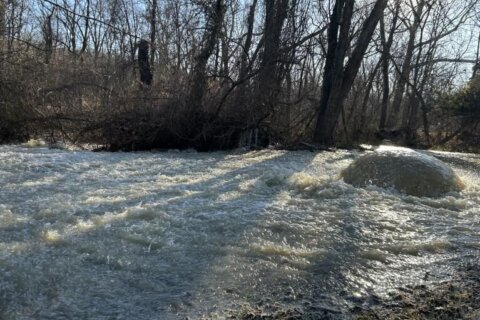
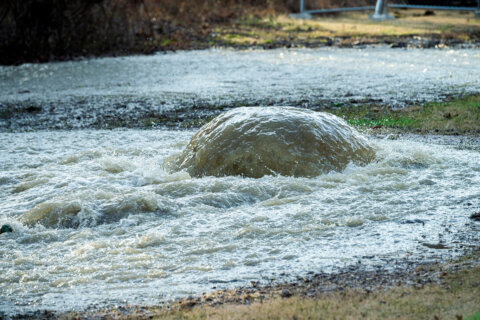
District officials said they’re getting a clearer picture of how much federal help will be available as crews continue repairing the collapsed Potomac Interceptor, which has dropped millions of gallons of sewage in the river since it ruptured in January.
During an update on repairs from D.C. Water, D.C. Homeland Security and Emergency Management Agency Director Clint Osborn said the current federal emergency declaration does not allow the District or D.C. Water to recoup money already spent on repairs.
Osborn said early indications that the federal government would cover 75% of the total repair and cleanup were misunderstood. He said that percentage only applies when federal agencies directly perform work assigned through the emergency declaration, and does not cover the repair work D.C. Water is carrying out.
“We’re going to continue to work through the preliminary damage assessment process with FEMA this week to determine whether we can convince FEMA and the White House to upgrade us to a major disaster declaration, which would get us reimbursement,” Osborn said.
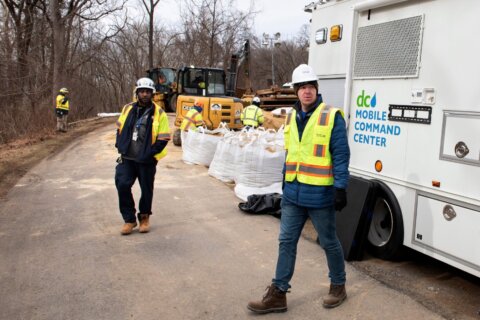
At the repair site, D.C. Water spokesperson Sherri Lewis said crews have expanded the excavation area to reach a large rock and debris blockage inside the pipe.
Lewis said crews have removed a significant portion of the blockage.
“We’ve removed sections of the pipe over the last couple of days, and so far, have removed about 45 feet of that rock and debris dam. We’re now down to maybe the last eight or 10 feet,” Lewis said.
After the remaining debris is cleared, crews will clean the inside of the pipe, install steel reinforcement and apply geopolymer to rebuild the interior surface. Lewis said the geopolymer is put on in layers, and each layer needs time to cure until they achieve the needed thickness.
Lewis said D.C. Water is still on track to finish the emergency repair by mid-March. She also said there have been no overflows into the Potomac River since Feb. 8 and that D.C. Water has added a 14th pump to strengthen the bypass system.
Osborn said the Environment Protection Agency will help the District move from weekly to daily water testing by providing laboratory support.
Lewis said downstream readings need to be viewed in the context of normal fluctuations that can be seen in the river, since any water quality spikes could simply be part of normal river behavior and not tied to the interceptor failure.
“You have to be cognizant of the normal urban river environment before drawing any conclusions,” Lewis said.
She also noted that federal officials have visited the site, including the EPA administrator and the secretary of the interior.
Residents should stay away from the work zone, Lewis said, adding people have been walking toward the construction area from Clara Barton Parkway.
D.C. Water also recently located an additional 2024 condition assessment of the pipe segment and is reviewing, it along with earlier reports.
“We are committed to a rigorous review process of that and reviewing those facts, and we do plan on sharing what we learn fully once it’s evaluated,” Lewis said.
Get breaking news and daily headlines delivered to your email inbox by signing up here.
© 2026 WTOP. All Rights Reserved. This website is not intended for users located within the European Economic Area.