This article was reprinted with permission from Virginia Mercury.
George Mason University officials said Thursday that no settlement agreement has been proposed with the federal government as it navigates four civil rights investigations, which began in July and are another issue that have shaped Virginia’s tumultuous higher education landscape this year.
Scrutiny of the institution and whether it would settle intensified after the University of Virginia signed an agreement with the U.S. Department of Justice to suspend multiple civil rights investigations.
The George Mason investigations focus on diversity, equity, and inclusion initiatives at the school, its employment practices and treatment of students, as well as a separate probe into alleged antisemitism on campus.
GMU President Gregory Washington said at Thursday’s Board of Visitors executive committee meeting that negotiations are still underway, but did not provide any timeline for a resolution. He also reiterated the institution’s plan to address the investigations head on.
“Wrong guy to throw these kinds of things at,” said Washington. “I’m not the guy that runs away from the fire. I’m the actual guy that runs into it.”
GMU Rector Charles Stimson, who faced criticism for holding a second executive committee meeting with only six voting members on the board, echoed Washington’s remarks and thanked him for his leadership during the ongoing process.
“I know these are tough times,” Stimson said. “You kept your chin up, and Mason is going to thrive when we come out the backside of this. We’re going to do the best we can for Mason because that’s our number one priority.”
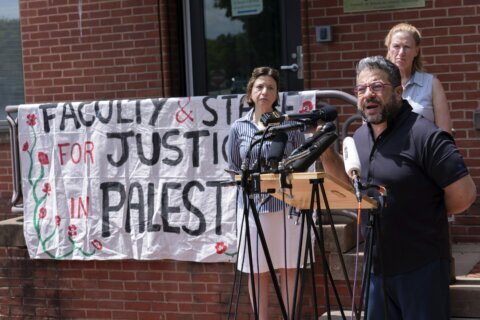
Meanwhile, outside of the meeting, a group of faculty members protested against the board, accusing it of meeting improperly because it lacked the required members to form a quorum. Some also claimed that the institution has a draft settlement agreement in place.
John Hollis, a spokesman for George Mason, told the Mercury that no draft settlement agreement exists.
“We must continue to send a very strong message to (President Washington) that there can be no settlement that compromises our academic freedom and our institutional autonomy,” said George Mason University-American Association of University President Bethany Letiecq.
Tim Gibson, president of the Virginia Conference of the American Association of University, also criticized the board for policies he said undermine academic freedom, including the IHRA definition of anti-Semitism and President Donald Trump administration’s diversity, equity, and inclusion redefinitions.
“The settlement agreement would force George Mason University to accept the Trump administration’s definitions of diversity, equity, inclusion programs,” Gibson said. “These programs would be redefined, not as what they are, which is a commitment to make George Mason University a welcoming environment for people from all walks of life, instead, these programs would be redefined as de facto discrimination against who? Against white people.”
Both educators said students, staff and university leaders should resist these policies and called for solidarity across institutions.
Earlier this week, UVA Interim President Paul Mahoney defended the university’s decision to enter into agreement with the DOPJ during a hearing with state senators.
UVA will not have to invest any money to complete the agreement, like Cornell University will, nor repay any money to the federal government, which Northwestern University must do.
Mahoney called the decision “the best option available,” because it suspends costly and disruptive investigations and preserves institutional autonomy and academic freedom. Democratic lawmakers say the agreement would open the school up to potential conflict with existing law,and infringed on state sovereignty.
Both schools are also awaiting a court decision on the future of Gov. Glenn Youngkin’s appointments to their respective governing boards. The Virginia Military Institute’s board is also named in that legal challenge.
Protest in Charlottesville
On Friday, professors and workers at the University of Virginia will hold a rally in Charlottesville protesting UVA’s Board of Visitors, which is facing claims it lacks the necessary representatives who are Virginia residents and alumni.
UVA also recently launched a search for a new president to lead the institution.
Gov.-elect Abigail Spanberger and Youngkin diverged on whether the university should continue its search, with Spanberger asking the board to halt the process until she takes office and Youngkin accusing her of inappropriately attempting to intervene in the process.
Friday’s protest organizers will also weigh in on the issue.
“It is disturbing if not surprising that this illegitimate UVA Board of Visitors seeks to further its power grab by rushing to appoint a new University President who will be loyal the anti-democratic agenda of Trump, Youngkin, and allied monied interests,” said Harry Szabo, president of the United Campus Workers of Virginia, a labor union of higher education workers in Virginia and one of the protest’s organizers.
Szabo said it’s the labor union’s “democratic duty” to oppose the board and to support a “university that serves the public good and promotes scholarship independent of the needs of billionaires or the ideologies of the powerful.”
“In other words,” Szabo added, “we need to defend the idea of a university of, by, and for the people.”