Students who attended a public Montessori program for preschool have better short-term memories and reading outcomes by the end of kindergarten compared to their peers, according to a new study.
Angeline Lillard, Commonwealth professor of psychology at the University of Virginia, worked on the study and said the Montessori preschool model had “significantly better outcomes for children relative to businesses as usual.”
The study followed students enrolled in public Montessori programs at 24 schools across the country, including in the D.C. region. The public Montessori kids had better reading outcomes, executive function and social understanding by the end of kindergarten, Lillard said.
“All things being average, the average child is going to do better in a Montessori environment than in another environment,” Lillard said.
While Montessori programs are often perceived as expensive private schools, Lillard said the approach is used in over 600 public schools. Montessori schools have trained teachers, three ages of kids in classrooms and a full set of Montessori materials.
Schools that use a Montessori model focus on what a human is like and how they learn, Lillard said, “whereas most of the models that we use really came out of adults’ ideas, not from studying children and watching them.”
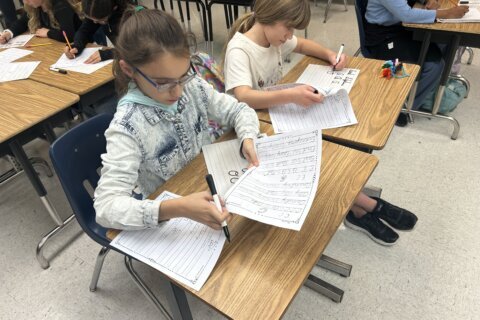
Montessori schools emphasize peer learning and encourage kids to learn based on their own interests. In those environments, students trace letters with their hands, “and we know that you learn much better how to read when it involves your body and when you learn how to write first,” Lillard said.
Because the student-to-teacher ratios are typically larger in the Montessori model, the study found three years of public Montessori classes for a child at ages 3 to 6 cost school districts over $13,000 less than traditional programs.
The improved student outcomes were recorded at the end of kindergarten, so while “the Montessori seemed to take some time to jell,” it led to “much better outcomes for lower cost,” Lillard said.
Other studies have similarly found that the Montessori model produces better outcomes, Lillard said.
“School decisions are very individual, and parents have to feel comfortable too when they’re doing something that’s an alternative model,” Lillard said. “It requires a lot of faith, so you have to know, ‘OK, I’m going along with what the research says.’”
Get breaking news and daily headlines delivered to your email inbox by signing up here.
© 2025 WTOP. All Rights Reserved. This website is not intended for users located within the European Economic Area.