As the United States marks its 250th anniversary, WTOP presents “250 Years of America,” a multipart series examining the innovations, breakthroughs and pivotal moments that have shaped the nation since 1776.
HII is proud to partner with WTOP to bring you this series.
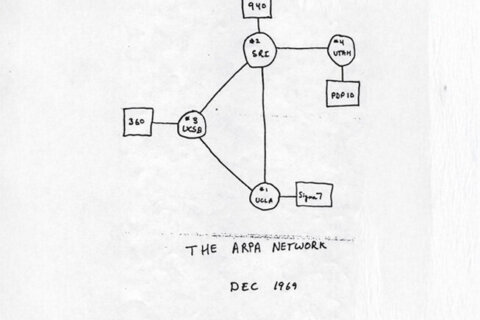
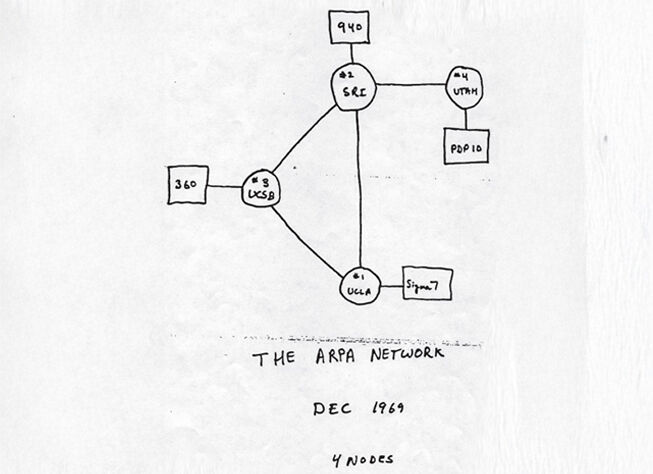
The origins of modern secure communications within the U.S. military and government trace directly to ARPANET, a Cold War-driven experiment that changed how information moved across networks and conflict environments. What began in 1969 as a Defense Department research project evolved into a communications architecture designed for survivability under attack.
At its core, ARPANET addressed a problem that had long challenged military planners: maintaining command and control if traditional communication systems were disrupted or destroyed. Earlier systems relied heavily on centralized infrastructure, including telephone switching networks. Those systems were vulnerable because a single point of failure could sever communications.
ARPANET introduced packet switching, a system in which data was broken into small units and sent across multiple paths before being reassembled at its destination.
Packet switching creates a more resilient system
The approach was more than a technical innovation. It was strategic. Because packets could be routed dynamically, communications could continue even if parts of the network were damaged. In a nuclear-era threat environment, that resilience was critical. The system was designed so no single node controlled the network. Instead, it operated as a distributed architecture that ensured continuity of operations under extreme conditions.
As ARPANET expanded through the 1970s, connecting universities, research laboratories and defense institutions, the military recognized another challenge. Data not only had to move reliably, but also across different types of networks, including radio, satellite and ground-based systems used by military units in the field.
That requirement led to one of the most significant developments in communications history: the creation of Transmission Control Protocol and Internet Protocol, known as TCP/IP.
TCP/IP connects networks across domains
Developed under the direction of the Defense Advanced Research Projects Agency, TCP/IP became the universal language allowing different networks to communicate seamlessly. The development marked a turning point. Data could move not just within a single system, but across an interconnected network of systems that eventually became the modern internet.
For the military, the change enabled integration across domains. Ground forces, naval assets and air operations could all be linked through shared data pathways.
Security becomes a growing priority
Security became a central concern as the network matured. By the mid-1970s, operational control of ARPANET transitioned to the Defense Communications Agency, and encryption mechanisms were introduced to support classified communications. The shift marked the beginning of a layered approach to secure communications, combining network architecture with encryption protocols to protect sensitive information.
The evolution continued in the early 1980s with another structural change. Military communications were separated into a dedicated network known as MILNET, part of the broader Defense Data Network. The separation ensured defense communications could be isolated from civilian and research traffic when necessary, adding another layer of operational security.
At the same time, controlled gateways allowed limited interaction between networks while maintaining security protections.
ARPANET’s legacy continues today
The legacy of ARPANET extends beyond the creation of the internet. Its deeper impact lies in reshaping secure communications through principles of decentralization, redundancy, interoperability and layered security that continue to define military and government networks today.
From battlefield data links to global command systems, the architecture that began with ARPANET continues to underpin how the United States secures critical communications. It transformed communication from a vulnerable chain into a resilient network capable of operating under pressure, adapting in real time and surviving in an era of evolving threats.
Get breaking news and daily headlines delivered to your email inbox by signing up here.
© 2026 WTOP. All Rights Reserved. This website is not intended for users located within the European Economic Area.