As the United States marks its 250th anniversary, WTOP presents “250 Years of America,” a multipart series examining the innovations, breakthroughs and pivotal moments that have shaped the nation since 1776.
HII is proud to partner with WTOP to bring you this series.
By early 1862, the age of wooden warships was already living on borrowed time. For decades, great fleets had been built of oak and powered by sail, but technology was quietly undermining their survivability. As Sam Cox, Director of the Naval History and Heritage Command, explains, “The problem started in the 1820s with the French development of guns that could fire exploding shells. And that by itself made wooden warships obsolete.”
The only reason wood endured was technical limitation. Early shell guns were dangerous, even to their crews. But once reliability improved, timber hulls became liabilities.
The reckoning came in Hampton Roads.
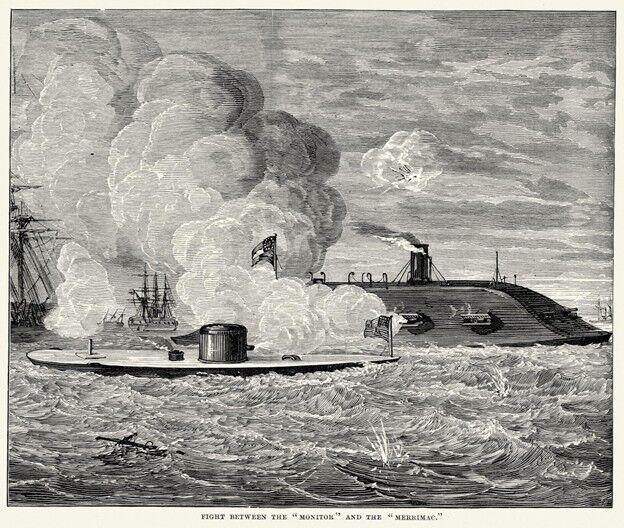
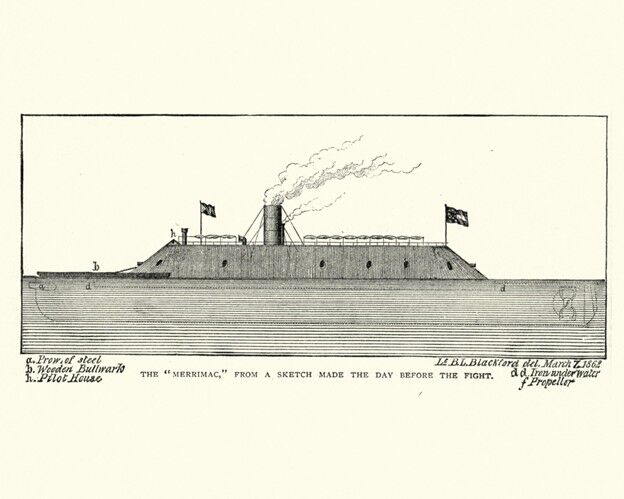
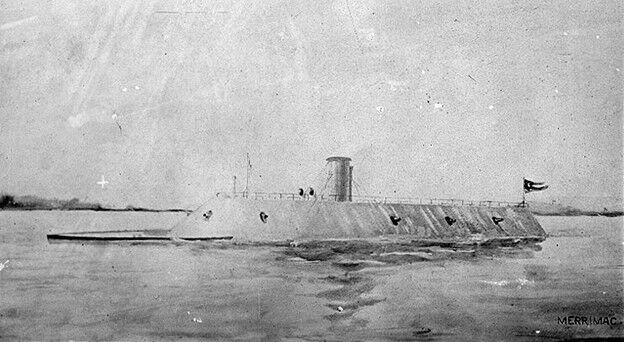
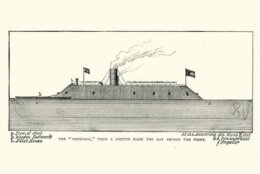
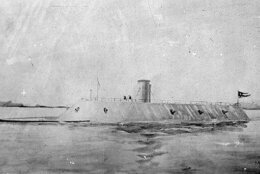
The Confederacy rebuilt the burned-out Union frigate Merrimack into the ironclad CSS Virginia. On March 8, 1862, she steamed into a Union squadron of wooden ships and methodically destroyed them.
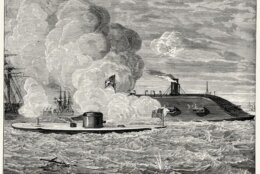
“The day before the battle with the Monitor,” Cox notes, the Virginia “sank two wooden Union frigates and drove a third one ashore. And there was practically nothing that we could do about it.”
Wood had met iron, and failed.
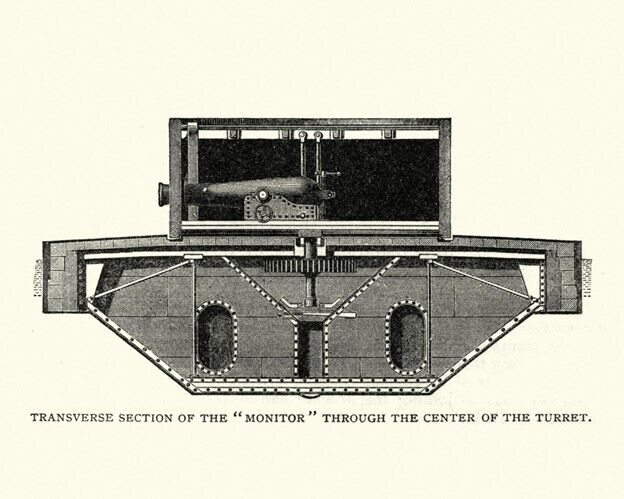
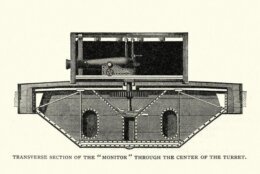
The next morning, the Union’s radical response arrived: USS Monitor. Low-slung, armored and built around a rotating turret, it represented a completely different design philosophy. “The arrival of the Monitor the next day,” Cox said, “basically a completely different design concept … made it an even fight and drove the Virginia back into port.”
The duel itself was tactically inconclusive. Strategically, it ended an era. The U.S. Navy understood quickly that wooden fleets were no longer viable against armored opponents.
Adaptation followed at speed. The Union built numerous ironclads, especially suited for coastal and riverine warfare along the Mississippi and Southern waterways. By the end of the Civil War, iron-armored vessels operated on both sides.
Even traditional wooden ships improvised. When USS Kearsarge fought the Confederate raider CSS Alabama off Cherbourg in 1864, the Kearsarge concealed iron chain armor along its vital areas beneath wooden planking. Confederate sailors protested what they called an unfair advantage. In reality, it was survival through adaptation.
Iron reshaped more than hull protection. It transformed naval architecture itself. Warships were no longer crafted primarily from timber; they were engineered systems requiring metallurgy, weight balance, reinforced frames and integrated propulsion.
And that shift demanded something larger: industry.
“Building ironclads and iron-hulled ships requires an extensive industrial base,” Cox explained.
Wooden ships could be built in more primitive conditions, though even they required skilled labor and specific timber. Ironclads required rolling mills, foundries, rail transport, and reliable access to raw materials. “It required a country to have access to the raw materials that make iron and steel,” he says. “Not all countries had that.”
Sea power was no longer just about seamanship, it was about national industrial capacity. “It drove a larger industrial base,” Cox concluded.
Yet progress did not move in a straight line. After the Civil War, the Navy entered a two-decade decline. Advances in iron-hulled and steam-powered ships slowed. For a time, wind again became primary propulsion. Cox described it plainly: “There was a backward period there.”
But the industrial transformation unleashed by the ironclad could not be undone. Wood would never again dominate serious naval combat. The clash at Hampton Roads marked the moment
American sea power entered the industrial age — when steel, engineering, and manufacturing capacity became inseparable from maritime strength.
The ironclad was not just a new ship. It was a new standard of power.
Get breaking news and daily headlines delivered to your email inbox by signing up here.
© 2026 WTOP. All Rights Reserved. This website is not intended for users located within the European Economic Area.