As the United States marks its 250th anniversary, WTOP presents “250 Years of America,” a multipart series examining the innovations, breakthroughs and pivotal moments that have shaped the nation since 1776.
Blue Cross and Blue Shield Federal Employee Program is proud to partner with WTOP to bring you this series.
As we march towards the 250th anniversary of our nation’s founding, WTOP is shining a spotlight on the part of the federal workforce who fights to keep the American Dream a reality, and the moment they achieved on the themes of the Declaration of Independence.
While “all men are created equal” stands as a crucial statement from Founding Father Thomas Jefferson, it remains a historical irony that our nation did not honor that promise for generations.
In 1776 our first federal workforce was a ragtag continental army.
Since then, the Department of Defense has grown into the nation’s largest employer with over 2 million service members and 800,000 civilians.
For nearly 170 years, those federal workers and service members were divided by race.
African Americans have served in every military conflict since the war with the red coats at the Battles of Lexington and Concord in 1775, but the armed forces weren’t integrated until the Korean War.
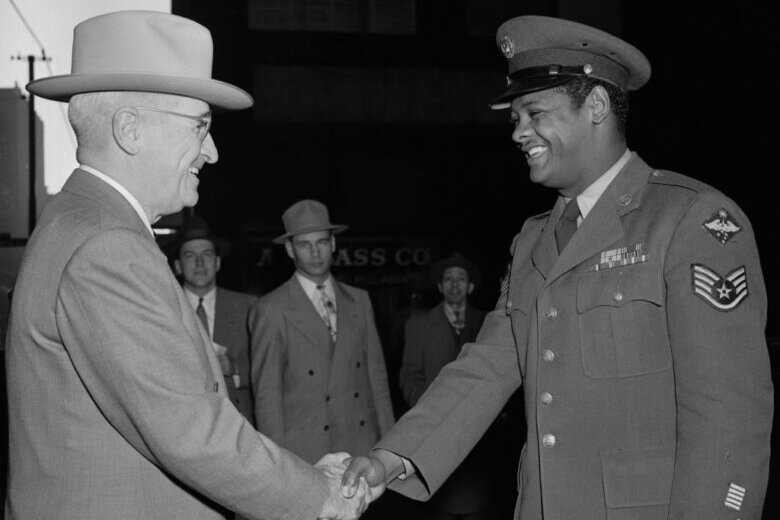
That was thanks to Independence, Missouri’s favorite son Harry S. Truman.
The 33rd president of the United States was a colonel in the U.S. Army and fought in World War I. Truman was not who most would have picked to become a trailblazer when it comes to civil rights.
This paragraph from the Truman Presidential Library explains why: “Harry Truman was known to have the prejudices of his community when it came to views of race. He used racial slurs, told racist jokes, opposed sit-ins and intermarriage and called Dr. Martin Luther King a troublemaker.”
But, on July 26, 1948, Truman surprised many by signing executive order 9981 and executive order 9980, ordering the integration of the military and the federal workforce.
While the desegregation of the federal workforce was a reversal of a 1913 order from President Woodrow Wilson, Truman was inspired to make the change in the military after hearing how Black veterans returning from World War II were being treated.
A little over a year before, “Give ’em Hell, Harry” became the first American President to address the NAACP on the steps of the Lincoln Memorial.
During Truman’s address, he spoke of civil rights and human freedom.
“We have reached a turning point in the long history of our country’s efforts to guarantee freedom and equality to all of our citizens,” Truman said. “It is more important today than ever before to ensure that all Americans enjoy these rights.”
As the crowd cheered, Truman said, “And when I say all Americans, I mean all Americans.”
It would take more than a decade before America’s fighting forces were fully integrated. But Truman’s executive orders would become a beacon of light, promising that all Americans could achieve life, liberty and the pursuit of happiness.
One of those people was a little 11-year-old black child who was living in the South Bronx in New York City. Years later, he had the opportunity to join the military and eventually went on to become the 12th Chairman of Joint Chiefs of Staff.
Gen. Colin Powell, the first Black American National Security Advisor, Chairman of the Joint Chiefs of Staff and Secretary of State, spoke at the Truman Library on the 50th anniversary of the signing of Executive Order 9981.
“The only institution in all of America, because of Harry Truman, where a young Black kid could now dream,” Powell said. “It’s the one place where the only thing that counted was courage, where the color of your guts and the color of your blood was more important than the color of your skin.”
Get breaking news and daily headlines delivered to your email inbox by signing up here.
© 2026 WTOP. All Rights Reserved. This website is not intended for users located within the European Economic Area.