A new housing development, supported by funding from the landmark housing bill passed last year, aims to help an unexpected group affected by the affordability crisis: middle-income Nevadans.
“We haven’t ever seen anything like it,” said Heidi Griffith, a mortgage loan officer who runs the homeowning-focused radio show ” Mortgage Matters.” “The law has created a lot of chatter.”
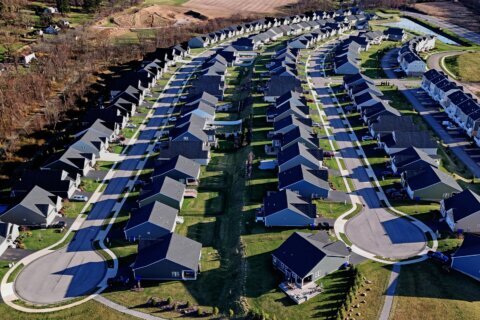
Paradise Trails, a new subdivision in southeast Las Vegas, is the first development to sell homes after receiving assistance from AB540, a bill introduced by Gov. Joe Lombardo (R) in the 2025 legislative session.
The law created a $133 million Nevada Attainable Housing Account (NAHA) to support development of single- and multifamily housing at prices middle-income families can afford. The bulk of that money is flowing to developers, but funding will also help local governments reimburse builders’ fees and permit costs and assist Nevadans with their mortgage or rent payments.
The investments in AB540 are distinct in their focus on middle-income residents who earn between 80 percent and 150 percent of area median income, which for a Clark County family of three is between $68,328 and $85,410, respectively.
Dedicating resources toward Nevadans making below 60 percent of average income, or around $50,000 for a family of three, is “typical of what housing finance agencies all across the country do, mainly because that’s very much tied to federal funding,” said Steve Aichroth, director of the Nevada Housing Division.
He said a wide range of federal programs — from housing vouchers to development assistance — target the lowest-income Americans, but “there’s not much” for Americans in slightly higher income brackets.
Aichroth said prices in Nevada have climbed so high even average earners can no longer afford a home. That was part of the impetus for AB540, which focuses on middle-income housing but includes millions of dollars for low-income rentals as well.
“The chasm between people renting and people having homeownership will just continue to get wider and wider,” said Rick Barron, president of Signature Homes, the development company that built Paradise Trails.
“I’m a believer in a continuum of housing to create opportunities for people to move up and have that housing available to the next group of people that want to buy,” Barron said.
The 29 single-family homes in Paradise Trails — which are now available for purchase — are in line with Nevada’s average housing costs. Barron estimated the monthly mortgage payment for the new houses would be around $2,000, similar to Nevada’s $2,000 median monthly mortgage payment in 2024.
Barron said monthly payments would have been closer to $3,000 if Signature Homes had not received more than $800,000 because of AB540, which requires participating developers to match the state’s contributions. The state’s investment mostly goes to homeowners to reduce their down payments and closing costs, while the developers’ matched funds are used primarily to buy down mortgage interest rates.
Griffith said she welcomes the state’s focus on down payments, which Nevadans sometimes struggle with more than their monthly mortgage payments.
“We know how much it takes to save for a down payment,” Griffith said. “We’re putting people into homes who didn’t ordinarily have the necessary funds for the down payment or closing costs to actually purchase a property and start that process of building wealth.”
The Paradise Trails homes are some of the nearly 6,500 new housing units that will be supported by AB540.
Nevada lags slightly behind the nation in homeownership, with roughly three-fifths of residents owning homes and the remainder renting. And homeownership continues to slide as prices rise. In 2025, Las Vegas saw the lowest number of home sales in nearly two decades, with approximately 28,500 sold.
Renters are also suffering. Only 14 affordable rental units are available for every 100 extremely low-income households. Low supply is causing prices to spike. In 2020, the median monthly rent in Nevada was roughly $1,150. In 2024 it was roughly $1,700.
Data from the 2024 U.S. Census indicated Nevada ranks second nationwide for its share of cost-burdened renters, meaning residents who dedicate more than 30 percent of their gross household income to rent.
The dearth of affordable housing made the state’s Division of Housing move quickly on releasing AB540 funds.
“We wanted to try to get this money out the door as fast as possible, so we can have it revolve as fast as possible, so we can make it as effective as possible,” said Aichroth.
His office announced in February it had awarded $86.1 million of the $133 million in the bill. Of the money that’s been spent, $22 million was earmarked for homebuyers who work in the fields of health care, education, public safety or construction. Other spending so far has included $15 million on low-income housing specifically, $9 million in grants to local governments and $11 million on land purchases (all of which have been in Clark County).
Most of the dollars that have been distributed so far are loans, which recipients are required to repay within two years. That’s given state officials hope that the money can return to the state’s coffers and bring further benefits via future redeployment.
“One of the things we’re striving for is for this to become a revolving fund,” said Aichroth. “We envision the $133 million cycling through a few times.”
A worsening crisis
Nevada has struggled with housing costs for years. The Legislature authorized a wide-ranging study in 2017 that determined the state’s supply of affordable housing was in crisis. The pandemic accelerated the problem, triggering a homebuying frenzy that increased prices and a temporary slowdown in construction with long-lasting ripple effects.
The Nevada-based think tank the Guinn Center for Policy Priorities wrote in a 2025 report that the state’s housing affordability crisis was in part due to its rapidly expanding population, onerous permitting processes, construction labor shortages and the outsize share of Nevada land owned by the federal government.
Tina Frias, the CEO of the Southern Nevada Home Builders’ Association, told The Indy in an interview that these issues slow down construction, which then drives up prices for potential buyers and makes future development harder.
Lombardo has repeatedly called for an end to red tape on housing construction, and AB540 aims to speed up the construction process in a variety of ways. It provided $23 million worth of loans so construction companies can purchase land for development and $25 million in grants to local governments to cover building and permitting fees. It also waived a requirement that construction companies with out-of-state licenses pay special fees to operate in rural areas.
Money for land acquisition is especially important for developers, said Frias, who called it “our number one issue.”
Politicians on both sides of the aisle have pushed to make it easier for Nevada to buy federal land, which accounts for about 85 percent of the state’s territory. At Wednesday’s event, Frias celebrated the governor’s signing of an agreement with the Bureau of Land Management last year that aims to make federal lands available more easily.
While the Paradise Trails development wasn’t the product of purchasing federal land, it was built on a vacant lot, sometimes referred to as infill.
Griffith, the host of the radio show on housing, said developing unused or abandoned areas in Las Vegas could be a better approach than buying federal lands, which is costly for the state and requires residents to live on the edges of town.
“We’re a sprawling city, always have been,” Griffith said. “But why are we picking up all the federal land when there’s infill pieces everywhere?”
Along with inadequate land availability, Frias said development is further delayed by regulations around permitting and building.
“Our industry is one of the most highly regulated industries there is,” she said.
Frias said she believes complex environmental regulations could be more forgiving.
“Our builders are really invested in sustainability, but sometimes when a code is being pushed down from the national level, on something like energy efficiency, it may not necessarily make sense here,” she said.
No ‘silver bullet’
Other Nevada housing advocates say the state needs more than just greater supply.
“Building isn’t a silver bullet,” said Ben Iness, the coordinator of the left-leaning housing nonprofit the Nevada Housing Justice Alliance. “We need to plan for the future in growth and development, but we need immediate protections or interventions … preventing needless rent hikes, rent gouging, evictions.”
He pointed to a 2025 study by the financial advisory firm LendingTree, which analyzed Census data to conclude Nevada has more than 123,000 vacant housing units.
“I think it’s really disingenuous to just say, let’s build and everything else will trickle down. … My fear is that we take the long and slow way,” he said. He favors a more immediate change, such as a temporary 5 percent cap on rent increases to give “folks time and space and peace of mind to weather that crisis.”
Iness described Lombardo’s focus on attainable housing for middle-income families as good in theory, but it “seems like a second-stage intervention” for after the current crisis has abated.
___
The Nevada Independent is a 501(c)3 nonprofit news organization. We are committed to transparency and disclose all our donors. The following people or entities mentioned in this article are financial supporters of our work:
___
This story was originally published by The Nevada Independent and distributed through a partnership with The Associated Press.
Copyright © 2026 The Associated Press. All rights reserved. This material may not be published, broadcast, written or redistributed.