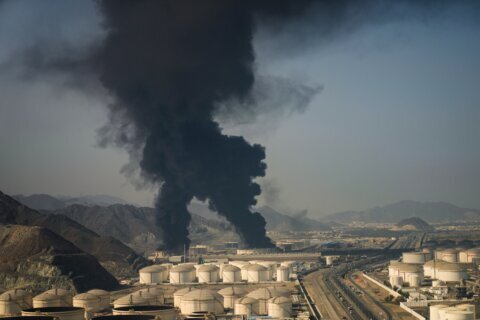
In one of the ironies of the Trump administration, oil prices are falling despite the president’s verbal and policy support for the domestic fossil fuel industry.
Domestic production in the long term could end up pressuring oil prices, and it appears that may have started already. But for the moment, traders are more worried about near-term production increases by OPEC and its allies and, perhaps more importantly, what President Donald Trump’s tariff policy will do to the global economy.
[Sign up for stock news with our Invested newsletter.]
“It seems like every country is bracing for a slowdown in growth over the next year, driven in large part by the Trump tariffs,” says Michael Martin, vice president of market strategy at TradingBlock. “If there is a slowdown, expect energy prices to fall.” Still, in the big scheme of things, ups and downs in oil prices and their effects on energy companies are hardly anything new.
“Energy companies are notoriously volatile,” Martin says. “Small changes in supply and demand — or a bit of geopolitical tension — can send prices soaring or falling on a dime.”
This volatility can make for outsized returns or losses, which means investors will want to include energy stocks within a well-diversified portfolio — or perhaps consider energy exchange-traded funds, or ETFs, for instant diversification. But one downside of ETFs is that they probably won’t perform as well as a single company that is doing particularly well for any number of company-specific reasons. So investors may also want to consider picking individual stocks.
“We suspect the energy sector, as a whole, may get more attention from investors looking for returns in other sectors now that the bloom is off of the rose in information technology,” says John Bocock, a portfolio manager at Pinnacle Associates. “The specific themes that we like are natural gas-fired power for surging information technology power demand and, in general, increased interest in offshore projects as onshore U.S. production struggles to grow.”
With that in mind, here’s a look at eight energy companies worth considering:
— SLB N.V. (ticker: SLB)
— Tidewater Inc. (TDW)
— Solaris Energy Infrastructure Inc. (SEI)
— Exxon Mobil Corp. (XOM)
— Chevron Corp. (CVX)
— BP PLC (BP)
— HF Sinclair Corp. (DINO)
— Darling Ingredients Inc. (DAR)
SLB N.V. (SLB)
SLB, formerly known as Schlumberger, is one of the world’s largest oilfield services companies. It helps oil and gas companies understand reservoirs, complete wells and optimize producing wells. The company is also involved in the energy transition, with geothermal, hydrogen, energy storage, lithium and carbon capture operations.
“SLB is the leading oil service company in the world, and we expect the company to benefit from increasing demand for its offshore technology and expertise,” Bocock says.
Maturing U.S. shale production is unlikely to be the growth driver it has been over the past decade, leading operators to boost their involvement with offshore projects, he says.
“If the stock or the sector begin to outperform, many large institutional investors may be compelled to buy SLB,” he says.
Tidewater Inc. (TDW)
This company operates vessels that support the global offshore energy industry, offering another play on the potential for offshore oil and gas exploration and production.
The company has also invested in offshore wind services, but not to the extent of some of its competitors. That now looks prescient, given the Trump administration’s moratorium on new offshore wind projects in U.S. waters.
Still, the offshore wind industry in Europe and Asia is much more advanced than in the U.S., and Tidewater’s global presence could provide the company with room to expand.
But for now, Tidewater is much more focused on the oil and gas industry.
Although it is a riskier story than Schlumberger, Bocock likes Tidewater’s potential given the amount of new floating production, storage and offloading vessels that should come online in the next few years that will require offshore supply vessel services.
“Tidewater believes its markets are beginning to improve,” he says. “TDW management says current day rates are substantially below levels that could justify widespread new builds — new supply/capacity — so, when the markets tighten, day rates and margins can improve materially.”
Solaris Energy Infrastructure Inc. (SEI)
Electricity demand in the U.S. has been relatively flat for many years. But that is changing as transportation and information services are increasingly requiring more electricity. Experts expect data centers that power artificial intelligence to create quite a bit more demand for electricity as computers that crunch AI data require more power.
New solar and wind farms will be able to power some of that, but not all. Natural gas is expected to be an important bridge fuel to provide baseload power until more nuclear reactors and battery storage units can come online.
This development stands to benefit Solaris, which provides power and logistics solutions to oil and gas operations, utilities, warehouses, and data centers.
“Solaris provides a variety of equipment and services to the traditional oilfield service market, but its recent expansion into mobile, natural gas-fired turbines has given the stock much better growth prospects,” Bocock says. “Database centers are finding that they need more consistent power than the grid can provide, and mobile natural gas-fired turbines are one of the best ways to get quality power installed quickly.”
Exxon Mobil Corp. (XOM)
“In an uncertain environment, large, well-capitalized producers are your best bet,” Martin says. “They can ride out the volatility, while smaller, more leveraged players may struggle to stay afloat.” That appears to be the case for Exxon Mobil, the second-biggest oil and gas company in the world behind Saudi Aramco.
Exxon has a global footprint that gives it geographic diversification that can cushion it from political turmoil in some of the far-flung places it operates.
The company is also diversified among business lines. It not only extracts oil and gas from the earth, it also owns pipelines that transport the commodities, refining operations that transform raw oil and gas into usable products, and retail-level gas stations where consumers fill up their cars.
Chevron Corp. (CVX)
Chevron is another vertically integrated oil supermajor, with similar business lines as Exxon.
“Exxon Mobil and Chevron are pillars in the energy sector,” Martin says, noting their large market capitalizations and cash piles. “This gives them the kind of stability smaller players just don’t have. They can weather any storm — whether it’s a global price shock or a political shift.”
If Trump’s U.S. oil initiative ends up increasing production and lowering prices, smaller producers could feel the pinch, possibly going out of business, Martin says. “Over the long run, this will likely lead to less competition, which will ultimately help these energy whales,” Martin says.
In fact, the U.S. Energy Information Administration said U.S. crude oil production hit a record high in June, rising 133,000 barrels per day. Meanwhile, new data from Baker Hughes shows the total number of active oil and gas drilling rigs is down 7% from last year.
BP PLC (BP)
Continuing the theme of stable oil and gas supermajors, BP is one of the biggest oil and gas firms in the world, giving it deep pockets to continue its traditional fossil fuel business. The company dabbled in renewable energy investments, but in February it announced a pivot back to oil amid falling investor confidence.
BP has been under pressure from activist investor Elliott Management, which wants to see cost savings and a management shakeup. Those changes could ultimately lead to better performance.
In April, BP pointed to gas projects in Egypt, Trinidad and Tobago, and the offshore border of Mauritania and Senegal. The company said the projects “contribute to BP’s reset strategy to grow oil and gas production.”
HF Sinclair Corp. (DINO)
This company is involved in a wide swath of the energy industry, with refining, midstream and marketing units. You might be familiar with the green dinosaur statues that adorn Sinclair gas stations, which are part of its marketing arm. Its midstream unit transports and stores petroleum products and crude oil, while its refining business refines crude oil.
DINO shares are outperforming peer stocks, up roughly 50% so far in 2025. Scotiabank recently reiterated its “sector outperform” rating, raising its price target from $61 to $66.
Darling Ingredients Inc. (DAR)
This company turns edible by-products and food waste into sustainable products and renewable energy. The company says it repurposes about 15% of the world’s meat industry waste streams into green energy, renewable diesel, collagen, fertilizer, animal proteins and meals, and pet food ingredients.
Darling is involved in a joint venture with Valero Energy Corp. (VLO) called Diamond Green Diesel, which produces fuel from used cooking oil, inedible animal fats and corn oil.
More from U.S. News
7 Best Water Stocks and ETFs to Buy
Trump Executive Orders 2025: Energy Stock Winners and Losers
7 Energy Stocks With Fat Dividend Yields
8 Best Energy Stocks to Buy in 2025 originally appeared on usnews.com
Update 10/13/25: This story was published at an earlier date and has been updated with new information.