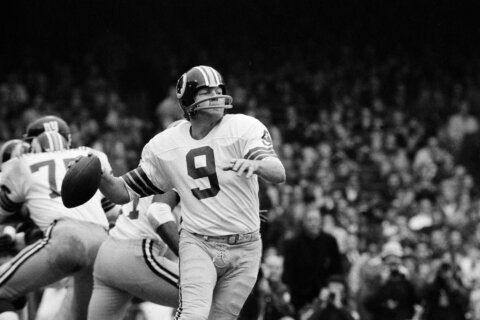
You can’t buy alcohol if you’re under 21, or tobacco until you’re at least 18 in most states. What if you couldn’t tackle or body check in sports until you were at least 15? That’s what many pediatricians and experts are calling for to reduce injuries like concussions.
“Knowing what we know now, why would we continue to intentionally expose our children to the risk of harm or risk of injury?” asks Dr. Bennet Omalu, a forensic pathologist who identified chronic traumatic encephalopathy in American football players, and whose research is the subject of the upcoming film ” Concussion,” starring actor Will Smith.
Earlier this month, U.S. Soccer announced in a legal statement that it will restrict the use of headers — bumping the ball off the head — in youth soccer players under age 10, plus limit use in practice among kids ages 11 to 13. And soccer isn’t the only sport taking such steps. The American Academy of Pediatrics’ Council on Sports Medicine and Fitness, for example, has proposed restricting body checking among boys under age 15 who play youth ice hockey. Body checks refer to one player’s attempt to separate another from the puck by forcefully colliding with him.
According to recent studies of high school sports, concussion rates in boys’ ice hockey were second only to football, and body checks contribute up to 30 percent of the time, says Dr. Keith Loud, interim chair of pediatrics and director of the Children’s Hospital at Dartmouth-Hitchcok in Lebanon, New Hampshire. What’s more, concussions are the most common injury among sports groups that allow body checking, according to a study published in Pediatrics in September.
“The rules [to prevent these injuries] already exist,” Loud explains. “In Massachusetts, they have developed an initiative where they’ve painted a line on the ice about two feet from the boards to remind players that it’s a danger area where there should be no contact within that two-foot radius.”
Basic Science Explains It All
Concussions can’t be detected on X-rays or other scans. Instead, doctors evaluate symptoms. Over time, repeated concussions can change a person’s concentration, problem-solving skills and mood. That’s why it’s important to recognize how concussions happen in order to prevent them. “Any time the head or body goes from fast-moving to stopping, the brain can shake around within the skull, and that’s when we think the concussion occurs,” Loud says, adding that ice hockey players move at an accelerated speed and are abruptly shoved into the barriers surrounding the ice — a maneuver that sends the body into a state similar to whiplash.
This theory of relativity is a basic scientific principal explained by Omalu’s research.
“Helmets will prevent injuries like fractures of the skull, contusions and lacerations of the scalp and face, intracranial hemorrhage and epidural hemorrhage, but helmets do not prevent acceleration or deceleration of the human brain inside the skull,” Omalu says.
For example, if two players are running at the same speed and collide helmet-to-helmet or shoulder-to-shoulder, the athletes will slow down very quickly. Therefore, the force that the body experiences is greater. The risk for injury is increased when there’s a wall or barrier, as is the case with ice hockey, Loud says.
That’s where muscle strengthening comes into play, says Dr. William Meehan, a member of the American Academy of Pediatrics’ Council on Sports Medicine and Fitness and director of the Micheli Center for Sports Injury Prevention in Waltham, Massachusetts. “The belief is if your muscles are strong, you’re less likely to be fatigued and will be able to keep your head up,” he explains. “It’s not so much the impact, but what happens after. During a collision, the force is inversely proportionate to the mass.”
The National Athletic Trainers’ Association recommends neck muscle strengthening as a preventive way to reduce neck fatigue and injury. In other words, athletes with stronger neck muscles may be able to take control of the whiplash-like movement that occurs when the body is slammed into during high-impact sports, reducing the likelihood of a concussion. “We’d like to think that if people could strengthen their necks, that could allow them to absorb contact better,” Loud says. Exercises can be as simple as moving the chin to the chest; the chin away from the chest; side-to-side, with the ear to the shoulder; and looking to the right and left. All these flexing movements can be done without machinery at the gym. Consider speaking to an athletic trainer before attempting them to avoid injury. And note that Loud emphasizes that more research is needed before making conclusive recommendations on the advantages of these exercises.
Don’t Discount Cheerleading
At any given sporting event, you’ll see another competition on the sidelines: cheerleading.
“Many athletic associations don’t recognize cheerleading as a sport, so it’s not under the umbrella of all the different protections that sports get, like requirements for pre-participation physicals, access to medical care, appropriate coach training facilities,” says Dr. Cynthia LaBella, medical director for the Institute for Sports Medicine at Ann & Robert H. Lurie Children’s Hospital of Chicago.
In 2012, LaBella and colleagues published a policy statement on preventing cheerleading injuries — including concussions — in the journal Pediatrics. The statement included 2009 data from the National Federation of State High School Associations, indicating there were 400,000 participants in high school cheerleading, with approximately 123,000 on competitive teams. Concussions and head injuries account for 4 to 6 percent of all cheerleading injuries, according to the statement. However, the rates increased by 26 percent each year from 1998 to 2008.
Her advice to parents is to ask about the policies in place for concussions, especially if it’s not considered a sport by the athletic organization; find out what the requirements are for trying different skills, such as jumping, dancing, flexing and serving as base — the bottom cheerleader who lifts or tosses another cheerleader — in competitions; and determine whether athletic trainers are available to assist with injuries at practice and competitions.
Recommendations
The AAP has rolled out several recommendations for different sports to curb the risk for concussions.
“Unfortunately for [concussion prevention], you’re at the mercy of the team you’re on, the coaches, the other teams, officials and the playing surface,” Loud says, calling it a public health issue. “Just as the greatest advances in highway safety come from speed enforcement.”
Boys’ youth ice hockey. The academy recommends expanding body-checking restrictions so they apply to boys 15 and older in addition to younger athletes and are in affect during games among the highest competition groups — not just youth teams. Loud and his colleagues also suggest coaches teach body checking during practices, starting with those who are 13 and have their sights set on professional play; that way, they’re better prepared for body checking at age 15. Other recommendations include enforcing a zero-tolerance rule against any contact to the head and reinforcing rules to prohibit body contact from behind, which could force a player into or near the barrier wall. The current culture allows for illegal hits, and Loud says that needs to change.
Youth football. The AAP calls on officials and coaches to help reduce concussions and fatal injuries among athletes. Many of these injuries occur because of illegal play, like head-first hits between players. The group also asks that tackling be removed altogether from football to decrease the likelihood of an array of injuries. The AAP acknowledges such a change would essentially change the fundamentals of the game, but asks players to weigh the risks and benefits of playing contact sports like football. Other recommendations include increasing the availability of non-tackling programs for youth athletes, making efforts to reduce direct head impacts, delaying the age when tackling is allowed, encouraging neck muscle strengthening and ensuring that more athletic trainers are present on the sidelines.
Cheerleading. The AAP wants cheerleading to be designated as a sport so its regulations can be enforced by athletic departments. Without such a designation, the AAP says cheerleaders are at risk for injury. In the meantime, the group recommends cheerleaders have a physical exam before signing up for the squad, and once they’re on board, they should have access to the same strength and conditioning programs as other athletes. The AAP also says cheerleaders should be supervised by qualified coaches who have proper training and certifications for gymnastics and partner stunts, safety measures and basic injury management. Cheerleaders should be trained and taught how to perform pyramids, mounts, tosses, tumbling and stunts only after they have shown progression of skill. The group recommends partner stunts and pyramids only be done on spring floors or with a landing mat on a traditional foam or grass/turf surface. And pyramids should be no more than two people high, with spotters — people who remain on the turf or surface and watch for any hazards during the mount or stunt.
Regardless of the sport, coaches, parents and athletes are encouraged to develop an emergency plan in partnership with the school in case of a concussion or other sports-related injury.
More from U.S. News
10 Concerns Parents Have About Their Kids’ Health
8 Cool Uses for 3-D Printers in Health Care
How Social Workers Help Your Health
How to Prevent Concussions originally appeared on usnews.com