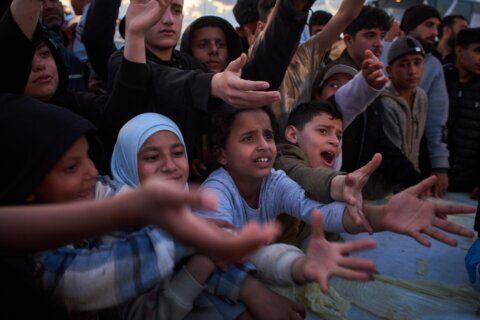
Last fall, when news organizations released photos of Alan Kurdi, the 2-year-old Syrian boy washed up on the Turkish coast, Lutheran Immigration and Refugee Service was bombarded with calls and emails. Americans from all over the country begged the refugee resettlement agency to allow them to adopt or foster Syrian children in need.
“It was a heartwarming, wonderful reflection of the community,” says Kimberly Haynes, director for children’s services for the organization. But then the group had to break the news: In the U.S. at least, there were virtually no unaccompanied Syrian children to adopt or foster.
Lutheran Immigration and Refugee Service, or LIRS, and eight other refugee resettlement groups have worked with the federal government to resettle roughly 17,000 Syrian refugees, including many children within family units, since the conflict broke out in the country in 2011. But of those, the State Department says only one has been a minor without a parent or guardian to care for him or her. Out of privacy concerns, they could give no details about the minor.
The U.S. has the capacity to accept more orphans from the war-ravaged country, Haynes and other experts say. It’s just that for now — as jarring as it might sound while Aleppo’s trapped children plead for help — there aren’t many Syrian minors who qualify for this particular form of assistance.
The Unaccompanied Refugee Minors Program in the United States is the only formal program in the world that is specifically designed to bring unaccompanied refugee children into a unique domestic foster care system, says Haynes. Since its founding after the Vietnam War, the program has accepted about 13,000 minors. It’s a relatively small program, admitting about 200 children last year.
The system gives refugees access to all the support available in the regular foster care system, but also provides additional assistance for things like language training and mental health services. It’s a federally funded program, and like all refugee resettlement services, can be changed or terminated at the whim of the president.
Children can come into the program a range of ways. They’re frequently referred by United Nations refugee agency partners based in other countries. In other scenarios, they’ve crossed the southern border and are classified as victims of trafficking or asylum seekers. LIRS works with another group, the United States Conference of Catholic Bishops, to place the children. The program prioritizes family reunification, meaning officials try to place minors with relatives who are able and willing to care for them before putting them in the foster care system.
There are several reasons why the UNHCR hasn’t been referring unaccompanied Syrian refugee minors to the U.S., experts say.
More than 1.1 million Syrian children are refugees, according to the United Nations refugee agency, but it’s unclear how many are unaccompanied minors. According to some reports, thousands of unaccompanied minors have streamed into Greece and elsewhere. But in general, experts say, these youth have been able to connect with family members.
In April 2016, for example, the Lutheran Immigration and Refugee Service and other nonprofits led a trip to Jordan, Lebanon and Turkey to look into whether there were significant numbers of unaccompanied Syrian minors that would have benefited from placement in the U.S.
[ The tragic numbers behind Syria’s refugees]
But in the three countries visited, “the mission found that almost every Syrian child who has been separated from parents or become unaccompanied is either quickly reunited with family or taken in by relatives,” according to its follow-up report.
About 80 percent of Syrian children who are unaccompanied are reunified with family members within two years, Haynes says. She attributes part of the connections to information sharing. Unlike some countries that experience an exodus of refugees, Syria is a nation with a strong telecommunications infrastructure.
[Five refugee crises you don’t know about, but should.]
Refugees show up on the border with a cell phone full of contact information, she says. Many find each other on Facebook. “This is a highly connected, highly communicative community,” she says. “It’s been astonishing to see the informal ways they learn about each other.”
Haynes also points out that the Syrian conflict is only about 5 years old, which is a relatively recent conflict compared to others in Africa or Asia. Ensuring that minors are truly unaccompanied takes time, she says. And once they qualify and arrive in the U.S., they can’t apply for any family member to join them in the U.S. until after they are 18.
“You don’t want to remove kids into the U.S. system unless you are really, really sure that they have no alternative,” she says.
If Syrian orphans do come down the pipeline, Ranya Shbeib encourages people to jump at the chance to foster them. A Syrian-American from Michigan, she has three biological children and one 17-year-old foster daughter from Somalia. Her city, called Bloomfield Hills, already has a significant Syrian-American population, and she’s been helping local families understand how to participate in the program.
“It’s definitely rewarding,” she says. “I have a belief that this will build character in my children and make them more globally minded. I see myself being a foster parent for life.”
More from U.S. News
The Young Face of the Refugee Crisis
Election of Donald Trump May Deter International Students from U.S.
Countries Hosting the Highest Proportion of Syrian Refugees
With Aleppo in Ruins, Only One Syrian Orphan Shelters in the U.S. originally appeared on usnews.com