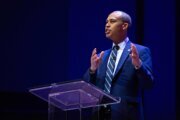
NEW YORK (AP) — Mega billionaire Amazon founder Jeff Bezos and his wife, former news anchor Lauren Sánchez Bezos, are awarding $5 million to the founder of a neurodivergent student support network, a recognition that the lesser-known recipient credits to the students powering his fast-growing movement for more inclusive classrooms.
“I feel like there’s a narrative sometimes that our little actions don’t matter,” Neurodiversity Alliance CEO David Flink said. “That’s just not true. And this proves it. Lots of little actions that happen every day in our work, collectively over time, reached the ears of folks like Lauren and Jeff.”
Flink is among this year’s five winners of the Bezos Courage & Civility Award. Given most years since 2021, the grant celebrates barrier-breaking individuals who unify people behind bold solutions to often neglected challenges. The no-strings-attached prize money can be used however honorees want to pursue their charitable goals.
The Neurodiversity Alliance began over 25 years ago as a peer-to-peer mentorship program for students with various learning and developmental differences such as autism, ADHD and dyslexia. The nonprofit now reaches more than 600 high schools and colleges, encouraging youth to build educational environments that serve classmates whose brains function differently from what is considered typical.
Other award winners announced Wednesday include Ilana Walder-Biesanz of National Math Stars, which supports young mathematicians, and Richard Rusczyk of The Mathcounts Foundation, which provides engaging math programs to middle school students. Kara Ball from Understood.org, a nonprofit that, like the Neurodiversity Alliance, supports those with learning differences including ADHD and dyslexia also received a $5 million award.
The Bezoses, who tied the knot this summer in a lavish Venice ceremony that drew protests highlighting wealth inequality, did not release any explanation for their support of the cause. The Amazon founder’s net worth sits around $240 billion, according to Forbes, making him the fourth richest person in the world.
Bezos has previously shown an interest in early childhood education through his nonprofit network of tuition-free preschools inspired by the Montessori model.
Sánchez Bezos grew up with undiagnosed dyslexia. She told “Good Morning America” last year that her children’s book, “The Fly Who Flew to Space,” is for “the 8-year-old me who was told I wasn’t smart.” She credited a college professor, who recruited her to the school newspaper despite her insistence that she could not spell, for encouraging her to get tested.
The selection of Flink marks a departure from the award’s previous higher profile recipients. Past honorees include CNN political commentator Van Jones, World Central Kitchen founder José Andrés, actor-director Eva Longoria and country superstar Dolly Parton. The shift reflects a desire to get the money closer to the ground rather than let well-known figures distribute money to the nonprofits of their choice.
The smaller scale approach differs from many of Bezos’ ultra wealthy peers, according to an Indiana University professor emeritus in public affairs and philanthropic studies. Leslie Lenkowsky said that today’s entrepreneur-philanthropists — Bill Gates, for example — tend to focus on systemic change in the realms of health or education.
“Rather than trying to change the system, what they’re trying to do is provide funding to individuals or communities to deal with important issues,” Lenkowsky said of the Bezoses. “It really is a much older model of philanthropy.”
The award’s size is also smaller this year. Five winners are equally splitting a $25 million pot whereas past awards have totaled as much as $100 million.
Flink said the money will help the alliance meet its goal of reaching more than 2,000 sites by 2028. He promised to invest in growing the mentorship program, telling more stories that challenge negative narratives about neurodiversity and expanding the national network of student leaders who get training to sustain their schools’ clubs.
He said this support is especially important when “the demand has never been greater” and they’ve witnessed “some oscillation” in the resources that schools receive.
The Trump administration’s dismantling of the Education Department has included mass layoffs at the agency charged with addressing complaints that students with disabilities are not receiving adequate support from their schools. Earlier this month, the department brought back dozens of Office for Civil Rights staffers, saying their help is needed to tackle a growing backlog of discrimination complaints.
Kala Shah, an attorney whose 24-year tenure at the Department of Education included enforcing protections for students with disabilities, said that neurodivergent students depend on that oversight.
“This is an especially critical time for private foundations and philanthropy to help fill the gap in resources that’s been created by the current federal climate,” she said.
__
Associated Press coverage of philanthropy and nonprofits receives support through the AP’s collaboration with The Conversation US, with funding from Lilly Endowment Inc. The AP is solely responsible for this content. For all of AP’s philanthropy coverage, visit https://apnews.com/hub/philanthropy.
Copyright © 2026 The Associated Press. All rights reserved. This material may not be published, broadcast, written or redistributed.