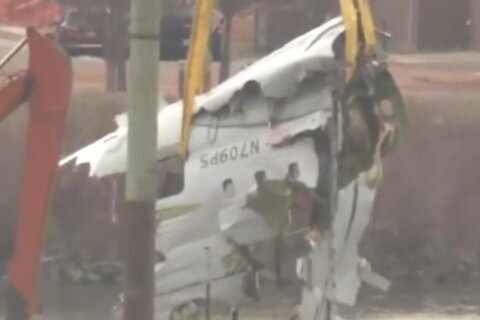
The National Transportation Safety Board is now reviewing three days of testimony from last week’s public hearings into the Jan. 29 midair collision near Reagan National Airport that killed 67 people.
One of the country’s leading aviation safety analysts believes that sweeping changes are likely to come not only to the operations near DCA, but to the entire aviation system as a result of this crash.
Former NTSB and FAA investigator Jeff Guzzetti says the DCA crash involving the American Airlines jet and the Army Black Hawk helicopter that killed 67 people on the two aircraft on Jan. 29 is the type of incident that causes fundamental changes in the way airports, airlines, the military and other stakeholders operate.
“These three days of hearings served as a week of reckoning for the FAA and for the U.S. Army,” he said. “My biggest takeaway is the fact that there’s plenty of data to indicate that this accident was preventable and that even though the hazard was known and identified, no one really took any action to separate the Army traffic from the airlines in and around the very congested airspace of National Airport.”
Exceptionally crowded airspace
Guzzetti said the hearings showed both the FAA and Army made numerous mistakes concerning the way it handled operations around DCA and the nearby Pentagon before the crash. Numerous reports had shown both agencies were aware the airspace was exceptionally crowded and there had been hundreds of near collisions in the years before the two aircraft collided in January.
“I think you’re going to see recommendations related to the airspace in and around Washington National Airport and … recommendations relating to the mixing of helicopter traffic with airline traffic,” he said.
“I think there’s going to be a lot of recommendations coming out of this relating to night vision goggles, airspace design, airline operations, Guzzetti added. “So, the NTSB will do their best to support each one of those recommendations.”
Guzzetti said he also would not be surprised if the NTSB recommends a reduction on the number of flights out of the already crowded airport, as Virginia’s two U.S. Senators Mark Warner and Tim Kaine have urged.
“They got a lot of evidence from the last three days. They’ve got testimony from many, many different people, the U.S. Army, FAA, executives, air traffic controllers and the airlines, and they’re going to put all of that perspective together in a context,” he said. He thinks this accident won’t be the result of one single cause but will have a long list of contributing factors.
“The public hearing is over now, it’s a heavy lift to present a public hearing to get these people in to testify, but now that’s behind them,” he said.
Expect a landmark report with major impact
Guzzetti believes the NTSB will now use the transcripts and the knowledge that came out of the testimony over the past three days to help them conduct a thorough analysis to create a detailed report that will list all of the contributing factors.
The NTSB is not a regulatory agency, it makes recommendations, but Guzzetti said in this case because of the high-profile nature of the crash, the NTSB sits on the White Horse of safety for many of the recommendations that will eventually be enacted.
Among the recommendations that Guzzetti predicts NTSB will put forward are ones related to the airspace in and around Washington National Airport and others relating to the mixing of helicopter traffic with airline traffic, “that just doesn’t pertain to Washington, D.C.,” he said.
Other areas include recommendations related to newer technology that can be used to help prevent these types of accidents, such as that ADS-B should be turned on in military aircraft, he said.
ADS-B is GPS-based technology that provides pilots and air traffic controllers with more situational awareness about where other aircraft are in relation to the position of their aircraft. At the time of the DCA collision, the Black Hawk helicopter’s ADS-B system was turned off because the Army did not want the aircraft to be tracked.
Sen. Ted Cruz (R-Texas) last week introduced legislation in the Senate that would require all aircraft manufacturers to install the technology and have it operating on all flights, and it would mandate in most cases that the Army keep those units turned on when flying.
Guzzetti said, going forward, this crash will be studied for years to come, and as a result he believes aviation will be safer, because important changes will be implemented.
“We’ve got a lot more airplanes flying and the public just simply won’t tolerate fatal airline accidents anymore. So yes, I think this accident will serve as a watershed event that people will look back on and say aviation is safer because of what we learned from this investigation,” he said.
The final NTSB report, including recommendations, is expected in the Spring of 2026.
Get breaking news and daily headlines delivered to your email inbox by signing up here.
© 2025 WTOP. All Rights Reserved. This website is not intended for users located within the European Economic Area.