This article was reprinted with permission from Virginia Mercury.
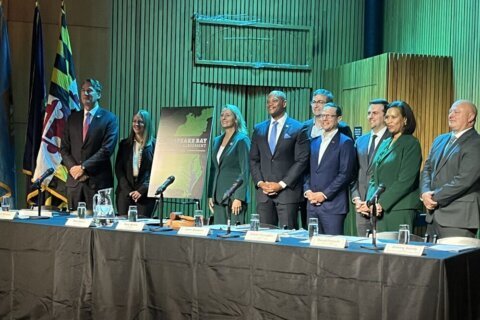
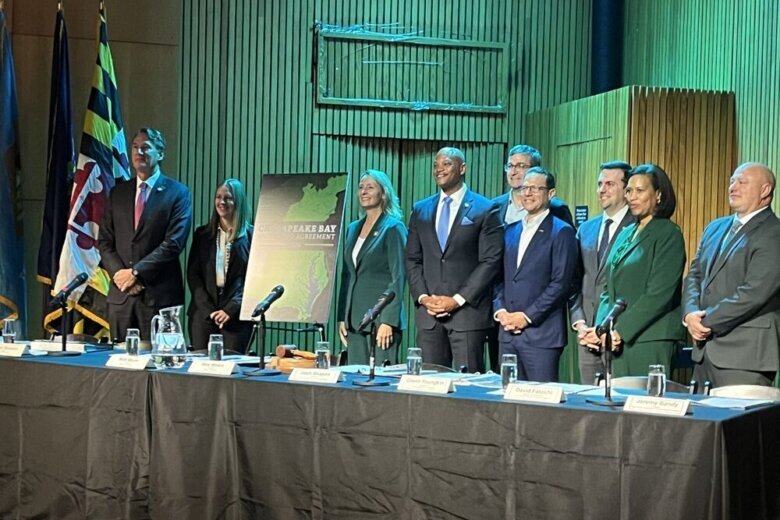
“We have a shared future here, and if we don’t address that shared future in a collaborative way, every single one of us will lose,” Delaware Gov. Matt Meyer said Tuesday in Baltimore, where Virginia Gov. Glenn Youngkin, Maryland Gov. Wes Moore, Pennsylvania Gov. Josh Shapiro, Washington, D.C. Mayor Muriel Bowser and other regional representatives enacted a new, 15-year agreement to reduce pollution, build habitats, and protect the Chesapeake Bay.
The Bay is part of a network of over 180,000 miles of streams, creeks, and rivers and is the largest estuary in the country. The states surrounding the 64,000 square mile watershed have been working for decades to clean up the water, combat climate change impacts, and make the water more accessible. The Bay is the common denominator between the localities, which have unique environmental needs but a singular objective when it comes to the Bay, the officials acknowledged.
“But regardless of what separates us, we’re all united here with a common goal: protect the Bay, protect its history, protect the people who are alive and rely on this for livelihood,” said Maryland’s Gov. Wes Moore. “Protect the chance that for each and every one of our future generations, they can have something that they can flourish in and enjoy.”
The Chesapeake Bay Watershed Agreement was originally drafted in 1983 to bring the states surrounding the bay together to clean up the water and preserve critical habitats and wetlands. The last agreement was signed by Virginia, Maryland, Delaware, West Virginia, New York, Pennsylvania, the District of Columbia, and Environmental Protection Agency officials in 2014.
The 2025 agreement focuses on four main goals and has 21 outcomes the states can strive for over the next 15 years.
Reducing pollution remains a key focus
Part of the agreement requires states to reduce the amount of pollutants each allows into the Bay.
The EPA established Chesapeake Bay Total Maximum Daily Load (TMDL) in 2010, which calculated the amount of sediment, nitrogen and phosphorus reductions needed at that time to restore the bay to a healthy level. Since then, Virginia’s progress towards the goals has been mixed, with the state having met 49% of the nitrogen reductions, 64% for phosphorus, and 100% of sediment reductions.
The TMDL is managed by the EPA and the maximum amounts allowed in the Bay will not be changed in the new agreement. It would take federal approval to put more enforcement behind the requirements.
Models by Chesapeake Progress, a tool that helps track states’ progress towards TMDL goals, show that while Virignia has greatly reduced its phosphorus running off into the waterway, it is still the largest polluter of the surrounding states and the third largest for nitrogen.
Virginia’s progress
Virginia’s gains in reducing sediment and other harmful chemicals in the Bay has been largely thanks to efforts through the cost share program that allows producers to apply for grants to help them implement best practices that reduce the amount of runoff from their farms.
Virginia has made strong strides in sediment reduction, oyster reef growth, blue crab abundance, and many of the 31 outcomes and ten goals laid out by the agreement in 2014. The commonwealth is behind in its goals for wetland protection, aquatic vegetation, forest buffers, and climate adaptations.
“I think we’ve settled on a very good framework that sets 2040 as the next huge milestone date and yet provides intermediate checkpoints along the way,” Virginia Gov. Glenn Youngkin said. “Checkpoints that hold ourselves accountable so that we will indeed see the kind of progress that we’ve made in the last four years continue.”
Tweaked language concerning climate
Unlike the 2014 agreement, which included a goal for the Bay “to withstand adverse impacts from changing environmental and climate conditions”, the 2025 agreement does not state the word “climate” once. It uses language like “changing environmental conditions” to describe the goals for wetlands, habitats, and healthy landscapes.
When asked about this shift in messaging, Chesapeake Bay Commission Chair Sara Love said climate resiliency hasn’t been removed from the ultimate goals of the agreement.
“We are taking climate change and resiliency, not as a single goal, but taking it throughout every single goal, every single outcome. It is the lens through which we look at everything,” Love said. “So rather than actually taking it out, we’re spreading it throughout the entire agreement.”
More opportunities to invest in the Bay
This version of the agreement presents a broader scope of projects and waterways that can contribute to the restoration efforts.
Chris Moore, Virginia executive director of the Chesapeake Bay Foundation, said that the agreements’ efforts to have more direct connections between habitats, healthy landscapes, clean water and public education will help keep Virginia on track to meet the goals of the compact over the next 15 years.
“Virginia still is not investing, honestly, the resources that are peer states are when it comes to the Bay agreement, when it comes to education funding,” Moore said.
”So that’s obviously something right there that’s kind of directly out of the agreement that hopefully will come up during the General Assembly.”
With Tuesday’s singing, the governors also agreed to make recommendations for the best ways to bring the tribal nations of the Chesapeake Bay to the table for future discussions. Members of the seven federally recognized tribes in Virginia asked to be signatories on the agreement but were blocked by red tape.
The revised Bay agreement also includes new benchmarks for wetland restoration, crab, fish, and oyster population goals, and a promise to try and include more localities in the regional goals and outcomes of the agreement.
“I think this is a moment of hope and a moment of optimism for the Bay and for our respective states and the District of Columbia,” Shapiro said.