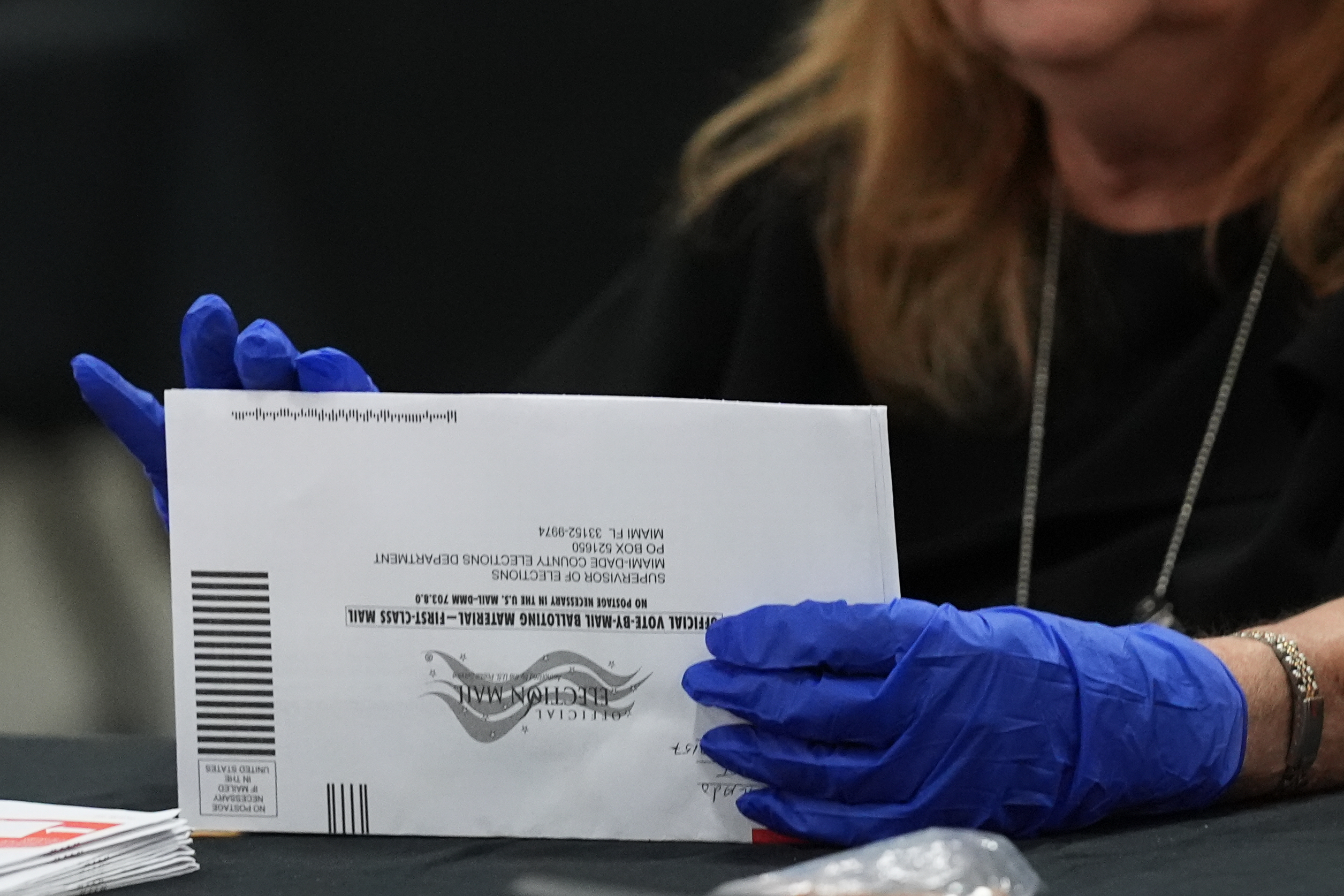
WASHINGTON (AP) — Michigan Sen. Elissa Slotkin asked Defense Secretary Pete Hegseth on Tuesday to confirm he won’t send U.S. troops to polling places during November’s midterm elections, as Democrats have raised concerns that the Trump administration could use the military to interfere with the vote.
“I’d ask you to confirm a simple statement: the Department of Defense will not send Federal troops to the polls or to seize election materials of any kind,” Slotkin wrote to Hegseth and to Gen. Dan Caine, the chairman of the Joint Chiefs of Staff, in letters Tuesday.
The Pentagon said in an email that it will respond directly to Slotkin, as it does with all congressional correspondence. The Joint Chiefs did not immediately respond to a request for comment.
Slotkin told The Associated Press that Trump has been laying the groundwork to claim the midterms were stolen. She noted that Trump contemplated using the military to seize voting machines after his loss in 2020 and has deployed the National Guard to cities against the wishes of Democratic leaders. He also deployed active duty Marines to Los Angeles during his immigration crackdown in 2025.
“He’s very clearly laying the breadcrumbs to be able to say the day after the election that he didn’t really lose the House or he didn’t really lose the Senate,” Slotkin said.
Slotkin asked Hegseth during an April congressional hearing if he would follow orders to seize ballots. Hegseth called the question a “gotcha hypothetical,” but said, “I’ve never been ordered to do anything illegal, and I won’t.”
White House chief of staff Susie Wiles denied in a Vanity Fair interview last year that Trump would use the military to suppress voting in the midterms.
“I say it is categorically false, will not happen. It’s just wrongheaded,” she said.
Federal law prohibits the deployment of armed federal forces to election locations unless “necessary to repel armed enemies of the United States.” If any element of the military were to get involved, it would likely be the National Guard under state control.
In 2020, Gen. Mark Milley, then-chairman of the Joint Chiefs of Staff, responded to a similar letter from Slotkin, then a congresswoman.
“I believe deeply in the principle of an apolitical U.S. military,” Milley wrote. “In the event of a dispute over some aspect of the elections, by law U.S. courts and the U.S. Congress are required to resolve any disputes, not the U.S. military.”